Early worsening of diabetic retinopathy is a transient deterioration of the retina after a rapid improvement in blood glucose control.
It was first recognized in trials of intensive insulin therapy.
It is also a source of confusion for patients and clinicians.
However, it does not mean that good control is harmful, because the long-term benefit is large, but it calls for extra care.
What Is Early Worsening of Diabetic Retinopathy?
In some patients with diabetic retinopathy, intensive treatment that lowers HbA1c quickly is followed within months by new cotton wool spots, more hemorrhages, and progression of the retinopathy grade.
In most cases the change is temporary.
The retinopathy then stabilizes and later does better than in patients with poor control.
Within the Diabetes Control and Complications Trial, early worsening, defined as a progression of at least three steps on the severity scale at six or twelve months, occurred more often with intensive therapy than with conventional therapy, at about 13 percent versus 8 percent, and recovered later (see the references).
Early Worsening of Diabetic Retinopathy: Proposed Mechanisms
- Reduced retinal blood flow and relative ischemia as the glucose falls and the retina adapts
- Upregulation of VEGF and other growth factors in response to the change in metabolism
- Changes in insulin-like growth factor and the signaling of insulin in the retina
- Closure of damaged capillaries, with cotton wool spots as a sign
The details are not fully understood, and several of these may contribute.
Fundus Explorer Pro
Photograph the retinal findings described here with the phone already in your pocket — 22 D optics and built-in illumination in one handheld unit.
From Choroida — the team behind this siteWho Is at Risk?
- Patients with long-standing diabetes and poor control at baseline
- Patients with moderate to severe nonproliferative or early proliferative retinopathy at baseline
- Those who achieve a large and rapid fall in HbA1c, for example by two percentage points or more in a few months
- Pregnant women, in whom retinopathy can progress quickly (see diabetic retinopathy in pregnancy)
- Patients who start insulin pumps, bariatric surgery, or potent new drugs
Reports have linked early worsening to the start of some newer drugs.
The relationship is discussed elsewhere (see GLP-1 agonists and diabetic retinopathy).
Screening and Follow-Up for Early Worsening of Diabetic Retinopathy
- Examine the retina before a major intensification of treatment, and document the grade
- Arrange a repeat examination three to four months after the start, and again at six months, in patients with moderate to severe disease or a large drop in HbA1c
- Treat vision-threatening changes as they arise, with panretinal photocoagulation or anti-VEGF therapy (see proliferative diabetic retinopathy)
- Control blood pressure and lipids in parallel
Patients with no retinopathy or mild disease are at much lower risk, and routine intervals are usually enough.
Why Control Should Not Be Delayed
The long-term data are clear.
Also, intensive control reduced the development and progression of retinopathy over the years in the DCCT and the UK Prospective Diabetes Study.
The benefit persisted for decades.
The temporary worsening in a minority is outweighed by the lasting benefit, so the right response is to monitor and to treat complications, and not to avoid good control.
An ophthalmologist should not advise a patient to slow down their glucose control without discussing it with the physician, unless there is a specific and urgent reason.
Early Worsening of Diabetic Retinopathy: Communicating With the Diabetes Team
- Send the retinal grade and the risk to the physician before intensification, whenever possible
- Ask the physician to tell the eye clinic about large changes in treatment
- Agree on a schedule of examinations
- Share the message that the eyes will be watched, and that treatment is available if needed
This coordination reduces the chance of an unwelcome surprise.
Counselling the Patient
Explain that the eyes may worsen for a short time after sugar levels fall quickly, that it is often temporary, and that treatment is available.
Emphasize the importance of attending the follow-up visits, and reassure them that the better control protects the eyes in the long run.
Distinguishing Early Worsening From Other Causes
Not every worsening after intensified treatment is early worsening.
In addition, other causes include poor adherence to follow-up, the natural course of severe disease, pregnancy, hypertension, and kidney disease, which can all drive progression.
Check blood pressure and renal function when retinopathy progresses, and discuss these factors with the physician.
Typical Findings
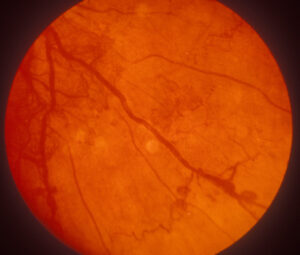
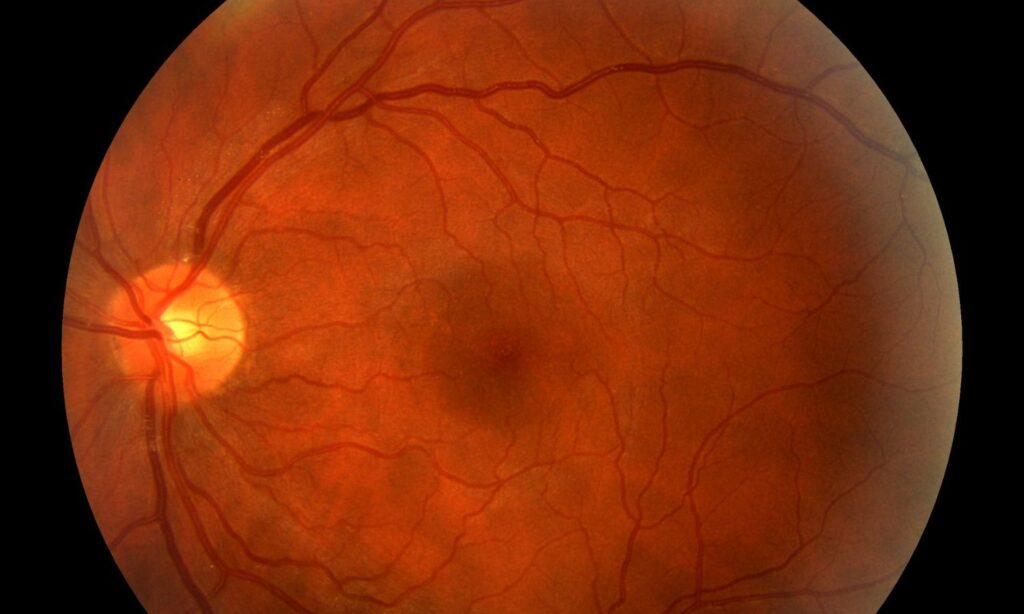
Early worsening shows as new cotton wool spots, intraretinal microvascular abnormalities, and retinal hemorrhages, sometimes with a change in the grade by several steps.
Also, most changes are mild, and only a minority progress to proliferative disease or macular edema that needs treatment.
For the latest studies, see the PubMed results for early worsening of diabetic retinopathy.


Document what you see
Two smartphone imaging tools built for everyday clinic use — one for the slit lamp, one for the fundus.
From Choroida — the team behind this siteReferences
- Diabetes Control and Complications Trial Research Group. Early worsening of diabetic retinopathy in the Diabetes Control and Complications Trial. Arch Ophthalmol. 1998;116:874-886.
- Bain SC, Klufas MA, Ho A, Matthews DR. Worsening of diabetic retinopathy with rapid improvement in systemic glucose control: a review. Diabetes Obes Metab. 2019;21:454-466.
- Ryan SJ, Schachat AP, Wilkinson CP, et al, eds. Retina. 6th ed. Elsevier; 2018.
- American Academy of Ophthalmology. Basic and Clinical Science Course, Section 12: Retina and Vitreous. AAO; current edition.

Writes and reviews the clinical articles on Educate. Every post is checked against peer-reviewed sources before it goes live.