Descemet stripping only treats selected cases of Fuchs endothelial dystrophy without a donor graft.
Also, the surgeon removes a central disc of diseased Descemet membrane and endothelium, and the peripheral healthy cells slowly migrate to fill the area.
It avoids rejection and tissue costs, but results are slower and less predictable than a graft (see Fuchs endothelial corneal dystrophy).
The Rationale for Descemet Stripping Only
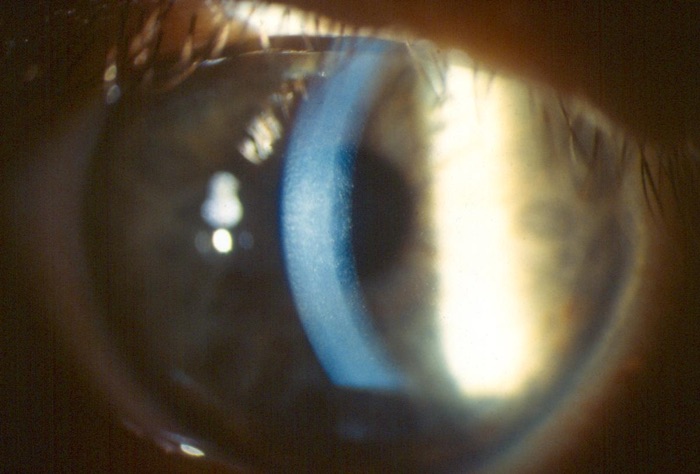
In Fuchs dystrophy, endothelial cells in the center of the cornea are the most affected, while the periphery is often healthier.
If the surgeon removes the central diseased area, peripheral cells may spread to cover it, and re-establish pump function.
Researchers described this idea years ago, and interest grew after the introduction of drugs that promote cell migration.
Descemet Stripping Only: The Procedure
- The surgeon also scores and strips a central circle of about 4 millimeters of Descemet membrane under viscoelastic or air
- The surgeon places no graft
- Finally, the surgeon may also leave a bubble of air in the chamber to hold things in place
- Clinicians give the patient topical steroids and, in many protocols, a ROCK inhibitor, such as ripasudil, for several weeks
The operation is short, and surgeons can combine it with cataract surgery in some cases.
All-fit Slit-Lamp Adapter
Record and share exactly what you see at the slit lamp. One adapter fits any slit lamp or surgical microscope — and any smartphone.
From Choroida — the team behind this siteRole of Rho Kinase Inhibitors
ROCK inhibitors promote migration and proliferation of endothelial cells, and shorten the time to clearing (see the references).
Studies of ripasudil after stripping show faster corneal clearing and higher success, but evidence from large randomized trials is still developing.
Descemet Stripping Only: Patient Selection
Good candidates have:
- Fuchs dystrophy with central guttae and edema
- Preserved peripheral endothelium on specular microscopy (see specular microscopy)
- Moderate edema without scarring
- No other corneal disease
In addition, poor candidates include eyes with low peripheral endothelial counts, advanced edema with scarring, or previous surgery that may have damaged the periphery.
Results of Descemet Stripping Only
- Many eyes clear within weeks to months, with a good visual outcome
- Some need months of treatment, and some fail to clear and need endothelial keratoplasty (see endothelial keratoplasty)
- Failure does not prevent a graft later, which makes the approach lower risk
- Outcomes depend on patient selection and on use of ROCK inhibitors
Advantages
- No donor tissue and no risk of graft rejection
- Fewer steroid drops after surgery
- Lower cost and a shorter operation
- Preserves options, since a graft remains possible
Descemet Stripping Only: Disadvantages
- Slow and variable recovery, with blurred vision for weeks to months
- A significant fraction of eyes do not clear
- Long-term data are limited
- The need for regular follow-up and drops
Postoperative Care
- Topical steroid, tapered over weeks
- ROCK inhibitor drops, several times a day, for the planned period
- Review every few weeks to track corneal thickness and clarity
- Decide on endothelial keratoplasty if there is no clearing at three to six months
Descemet Stripping Only: Counselling
Explain that the cornea may take weeks or months to clear, that a graft is the backup, and that the approach offers a chance to avoid donor tissue for appropriate patients.
An Example Case
A 62-year-old woman with Fuchs dystrophy has central edema and 20/60 vision, with a clear periphery and a healthy endothelial count at the edge.
She has Descemet stripping with cataract surgery, and starts ripasudil drops, and by twelve weeks her cornea has cleared, with 20/25 vision.
Had the cornea not cleared, an endothelial graft would have been the next step, so she lost no options.
Combining With Cataract Surgery
The stripping can be done at the same time as phacoemulsification, since corneal clarity improves afterwards, and the lens implant can be chosen without the concern of a later graft (see phacoemulsification).
Plan for slightly longer recovery, and discuss a hyperopic shift that can occur after endothelial procedures.
Research Needs
Randomized trials comparing ripasudil with placebo, and long-term follow-up, will help to define who benefits.
Patient Questions
Patients ask whether they will need a graft later.
Some will, and the plan is clear from the start, so the approach carries little extra risk.
Review the drops, the follow-up visits, and the expected time to clearing before surgery.
Key Messages for Colleagues
Select patients carefully, with central disease and a healthy periphery, and explain that the process takes time.
Set a date by which you will offer a graft if clearing has not occurred, which helps patients to plan.
Record corneal thickness and photographs at each visit, since the pattern of clearing guides decisions.
Cost and Resources
The procedure needs no donor tissue, which lowers the cost and removes dependence on eye bank supply, a benefit in regions with long waiting lists.
Also, the main costs are the drops and the visits, which are shared with other corneal procedures.
For the latest studies, see the PubMed results for Descemet stripping only.


Document what you see
Two smartphone imaging tools built for everyday clinic use — one for the slit lamp, one for the fundus.
From Choroida — the team behind this siteReferences
- Moloney G, Petsoglou C, Ball M, et al. Descemetorhexis without grafting for Fuchs endothelial dystrophy: supplementation with topical ripasudil. Cornea. 2017;36:642-648.
- Okumura N, Koizumi N, Ueno M, et al. Rho kinase inhibitor enables cell-based therapy for corneal endothelial dysfunction. Sci Rep. 2016;6:26113.
- Krachmer JH, Mannis MJ, Holland EJ, eds. Cornea. 4th ed. Elsevier; 2016.
- American Academy of Ophthalmology. Basic and Clinical Science Course, Section 8: External Disease and Cornea. AAO; current edition.

Writes and reviews the clinical articles on Educate. Every post is checked against peer-reviewed sources before it goes live.