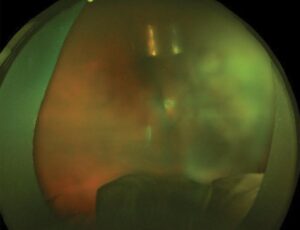
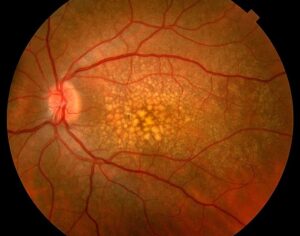
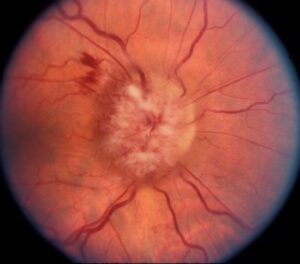
The Diabetic Retinopathy Study, or DRS, was the first large randomized trial to show that laser can save sight in diabetic eye disease.
It ran from the 1970s, enrolled more than 1,700 patients, and stopped early because the benefit of treatment was clear.
It defined the high-risk features of proliferative disease that still decide when scatter laser is urgent.
Why the Diabetic Retinopathy Study Was Done
Before this trial, proliferative diabetic retinopathy often ended in vitreous hemorrhage, traction detachment, and blindness.
Photocoagulation had been tried in small series, but nobody knew whether it helped or harmed, and whether doctors should do it before bleeding.
The National Eye Institute funded a multicenter trial to answer these questions (see proliferative diabetic retinopathy).
Diabetic Retinopathy Study: The Design
- Patients had proliferative retinopathy in at least one eye, or severe nonproliferative disease in both eyes, with good vision
- Investigators randomized one eye of each patient to photocoagulation and left the other untreated
- Investigators compared two techniques, argon laser and xenon arc, and both involved scatter treatment and direct treatment of new vessels
- The main outcome was severe visual loss, defined as visual acuity worse than 5/200 at two consecutive visits
Fundus Explorer Pro
Photograph the retinal findings described here with the phone already in your pocket — 22 D optics and built-in illumination in one handheld unit.
From Choroida — the team behind this siteThe Main Result
At two years, severe visual loss occurred in about 16 percent of untreated eyes and about 6 percent of treated eyes, a reduction of more than half (see the references).
The effect was strongest in eyes with high-risk characteristics, in which the benefit exceeded 50 percent at two years and persisted afterwards.
Investigators stopped the trial early for ethical reasons, and offered treatment to the control eyes.
Diabetic Retinopathy Study: The High-Risk Characteristics
Also, the study identified features that predicted severe vision loss without treatment.
- New vessels on or near the disc covering at least one quarter to one third of the disc area
- Any new vessels on the disc with vitreous or preretinal hemorrhage
- New vessels elsewhere covering at least half a disc area with vitreous or preretinal hemorrhage
Clinicians treat eyes with these findings promptly, which remains the rule today.
Argon Versus Xenon
Argon laser produced fewer side effects, such as less peripheral field constriction and less loss of acuity, than xenon.
It became the standard source, and later lasers followed the same principles.
Diabetic Retinopathy Study: Side Effects of Treatment
- Mild loss of peripheral visual field, which is more evident with heavy scatter
- Decrease in night vision and some loss of contrast
- A small drop in central acuity in some eyes, from macular edema made worse by laser
These costs are small next to the risk of blindness, though they matter when the choice is between laser and injections (see Protocol S).
What Changed in Practice
- Scatter laser became the standard treatment for high-risk proliferative retinopathy
- Programs built screening around finding the stage when treatment pays off
- Later studies added vitrectomy for nonclearing hemorrhage and traction
- The study standardized treatment technique, such as spot size and spacing
Diabetic Retinopathy Study: Limits
The trial ran before OCT and anti-VEGF drugs, and it used older laser equipment.
Patients had type 1 and type 2 diabetes, but the mix, and the medical control of that time, differ from today.
Counselling
Explain that laser treats the area outside the macula, so that vision at the center is preserved, and that night vision and side vision may be a little worse.
Stress that do not delay treatment because the eye sees well.
Scatter Laser in Practice Today
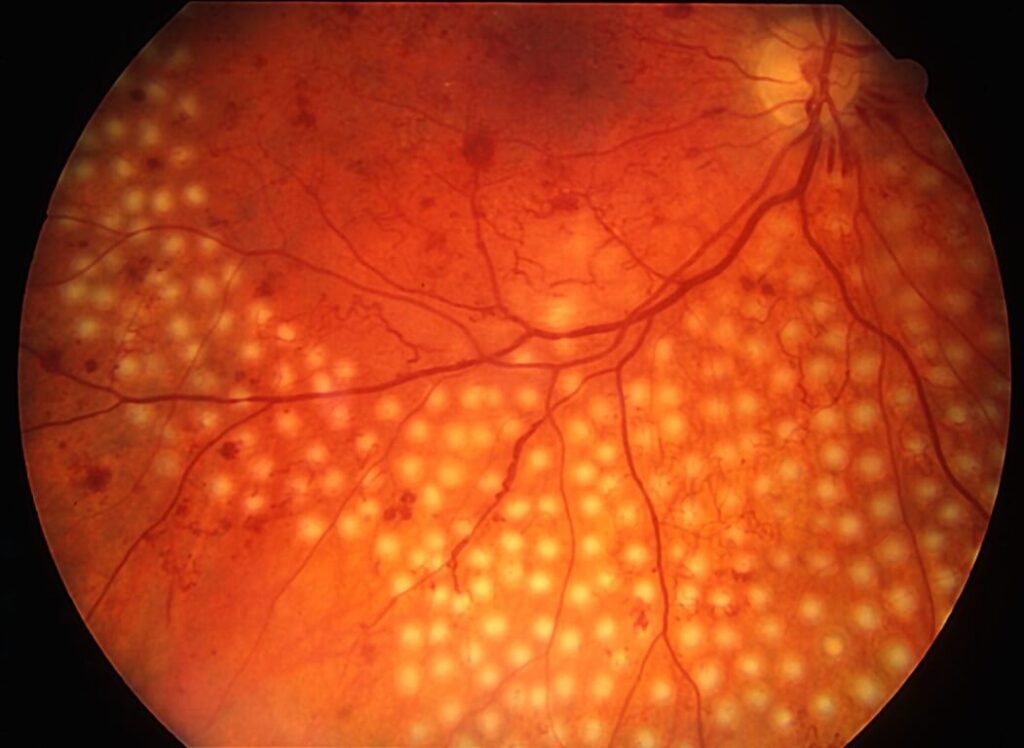
A typical session delivers 1,200 to 1,600 burns with a spot size of 200 to 500 micrometers, spread over one to three visits, sparing the macula and the area around the disc.
Clinicians apply treatment from the arcades to the far periphery, with spacing of about one burn width.
Common pitfalls include untreated areas in the far periphery, which allow new vessels to persist, and rapid heavy treatment in eyes with macular edema, which can worsen it (see panretinal photocoagulation).
Photographs and Documentation
Record the extent of laser on a wide-field photograph, and compare it with later images to find skipped areas.
Review the eye after a few weeks to confirm that new vessels regress, and add fill-in treatment if needed.
Comparison With Modern Options
Today, anti-VEGF injections and laser are both accepted treatments, and the choice depends on macular edema, adherence, and cost (see diabetic retinopathy).
The DRS findings still underlie the definition of high-risk disease, and eyes with these features should not wait for treatment.


Document what you see
Two smartphone imaging tools built for everyday clinic use — one for the slit lamp, one for the fundus.
From Choroida — the team behind this siteReferences
- Diabetic Retinopathy Study Research Group. Photocoagulation treatment of proliferative diabetic retinopathy: the second report of Diabetic Retinopathy Study findings. Ophthalmology. 1978;85:82-106.
- Diabetic Retinopathy Study Research Group. Photocoagulation treatment of proliferative diabetic retinopathy: clinical application of Diabetic Retinopathy Study findings, DRS report number 8. Ophthalmology. 1981;88:583-600.
- Ryan SJ, Schachat AP, Wilkinson CP, et al, eds. Retina. 6th ed. Elsevier; 2018.
- American Academy of Ophthalmology. Basic and Clinical Science Course, Section 12: Retina and Vitreous. AAO; current edition.

Writes and reviews the clinical articles on Educate. Every post is checked against peer-reviewed sources before it goes live.