CASE REPORT
A 75-year-old patient presented with decreased central vision in the right eye after cataract surgery which was done recently. He presented with no significant ocular or systemic history. His VA report was as follows RE: 6/18, LE: 6/9.
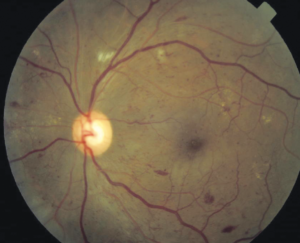
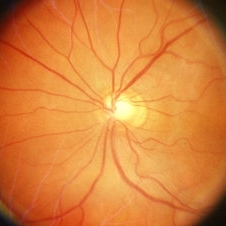
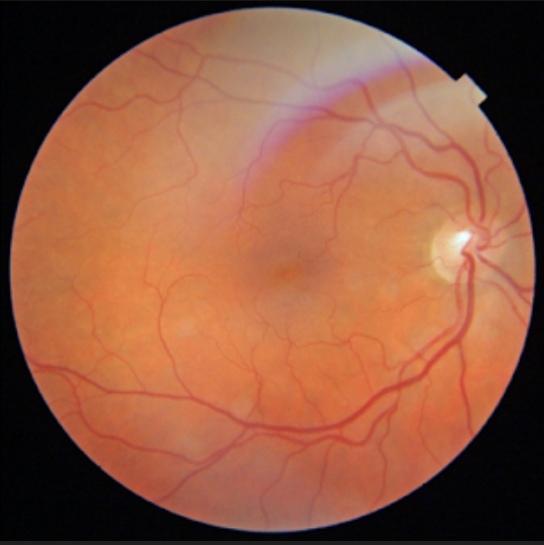
Pupillary reflexes, adnexa, anterior segment, ocular motility, and Intraocular pressure all were normal. On dilated fundus examination, the macular area appeared elevated or edematous due to the accumulation of fluid in the macular area.
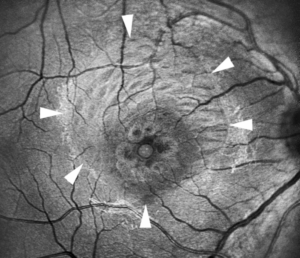
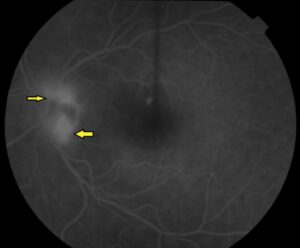
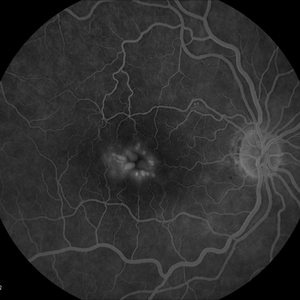
Fluorescein Angiography(FA) indicated leakage of fluorescein dye in retinal tissues. Optical Coherence tomography (OCT) showed retinal elevation with cystic spaces present in between the retinal layers.
Cystoid macular edema entity
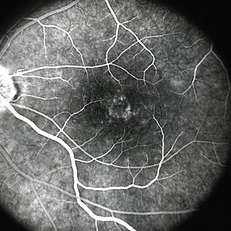
As the name suggests, Fluid filled cyst-like spaces occur at the central retina called the macula and cause its swelling in the form of edema.
Disruption of the normal blood-retinal barrier leads to leakage from retinal capillaries, and fluid accumulates in the extracellular spaces of the retina, causing thickening of the central retina. This is a painless disorder; mild cases may be asymptomatic.
The exact etiology is unknown, but some diseases cause CME like:
-
- Intraocular inflammation such as uveitis can further leads to Macular inflammation.
- Age-related Macular degeneration: In wet ARMD, abnormal blood vessels become permeable and leak fluid into the retina involving the macula thus leading to CME.
- Diabetic retinopathy: (Edema caused by it is diabetic macular edema).
- Central or branch retinal vein occlusion.
Due to occlusion of retinal veins, blood flow is disrupted thus contributing to CME
- Retinitis pigmentosa: This hereditary disease is also considered an etiological factor of CME
- Some surgical procedures can also lead to CME such as:
- Patients who have undergone cataract surgery are at increased risk of CME.
- Pars plana Vitrectomy (PPV)
- Photocoagulation
- Cryopexy
- Glaucoma surgery
The patient may present with the following complaints:
- Decreased vision
- Metamorphopsia (a condition in which an object appears wavy when looking straight ahead at the object).
- Micropsia
- Loss of color vision
- Loss of contrast sensitivity
- Central scotoma
Fundus Explorer Pro
Photograph the retinal findings described here with the phone already in your pocket — 22 D optics and built-in illumination in one handheld unit.
From Choroida — the team behind this siteCystoid macular edema management
Medical treatment:
- Corticosteroids :
They can be given topically, periocularly, systemically, or as an intravitreal injection or implant.
E.g Intravitreal triamcinolone can be helpful in reducing fluid accumulation and decreasing VEGF production.
Four categories of intravitreal implants are as follows
- Dexamethasone biodegradable implant
- Helical triamcinolone acetonide implant
- Fluocinolone acetonide implant
- Injectable Fluocinolone acetonide
Their side effects may include cataract formation and glaucoma
- Anti VEGF :
These include ranibizumab and bevacizumab
- Carbonic Anhydrase inhibitors (CAIs)
- Pharmacologic vitreolysis agents
Surgical Treatment:
- PPV (Pars Plana Vitrectomy)
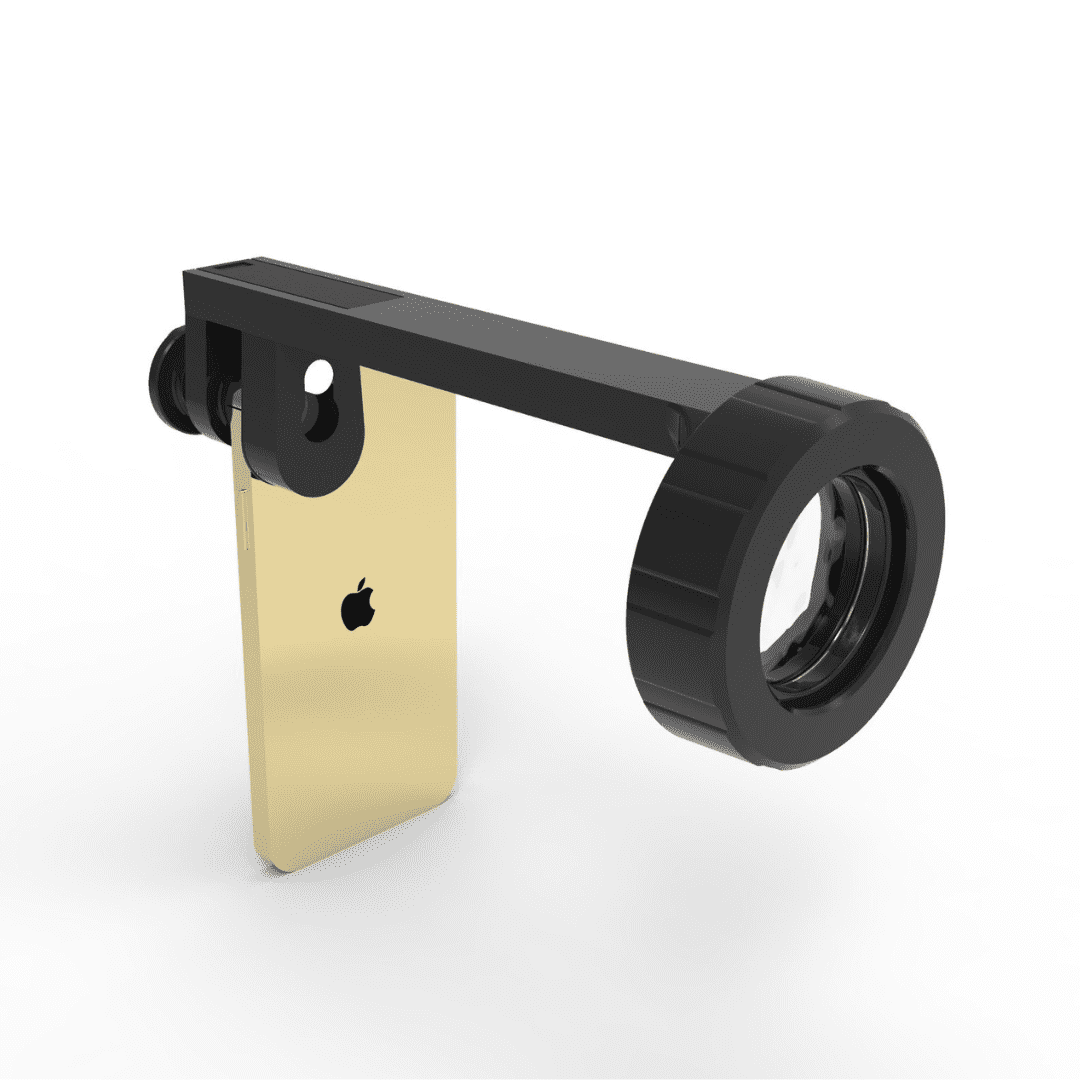
Document what you see
Two smartphone imaging tools built for everyday clinic use — one for the slit lamp, one for the fundus.
From Choroida — the team behind this siteREFERENCES
- Abe T, Hayasaka S, Nagaki Y, et al. Pseudophakic cystoid macular edema treated with high-dose intravenous methylprednisolone. J Cataract Refract Surg. 1999;25:1286–8.
- Aiello LP, Pierce EA, Foley ED, et al. Suppression of retinal neovascularization in vivo by inhibition of vascular endothelial growth factor (VEGF) using soluble VEGF-receptor chimeric proteins. Proc Natl Acad Sci U S A. 1995;92:10457–61.
- Aiello LP, Bursell SE, Devris T, et al. Protein kinase C beta selective inhibitor LY333531 ameliorates abnormal retinal hemodynamics in patients with diabetes. Diabetes. 1999;48:A19.
- Gass JD, Norton EW. Follow-up study of cystoid macular edema following cataract extraction.Trans Am Acad Ophthalmol Otolaryngol. 1969;73:665-682.
- Hogan P, Dall T, Nikolov P. American Diabetes Association: Economic costs of diabetes in the US in 2002. Diabetes Care. 2003;26:917-932.
- DeCross FC, Afshari NA: Perioperative antibiotics and anti-inflammatory agents in cataract surgery. Curr Opin Ophthalmol 2008;19:22–26.
- Panchapakesan J, Rochtchina E, Mitchell P: Five-year change in visual acuity following cataract surgery in an older community: the Blue Mountains Eye Study. Eye 2004;18:278–282.
Test yourself
A few questions straight from this article.
-
In cystoid macular edema after cataract surgery, which OCT finding is described?
In the post-cataract case, OCT showed retinal elevation with cystic spaces lying between the retinal layers. -
What does fluorescein angiography show in cystoid macular edema?
FA in the case demonstrated leakage of fluorescein dye into the retinal tissues, alongside the macular elevation seen on fundoscopy. -
Which procedure is listed as a surgical cause of cystoid macular edema?
Surgical causes listed include cataract surgery, pars plana vitrectomy, photocoagulation, cryopexy and glaucoma surgery. -
How does wet age-related macular degeneration lead to cystoid macular edema?
In wet AMD, abnormal blood vessels become permeable and leak fluid into the retina involving the macula, producing CME. -
Which hereditary retinal disease is listed as an etiological factor of cystoid macular edema?
Retinitis pigmentosa, a hereditary disease, is listed among the causes of CME alongside uveitis, wet AMD, diabetic retinopathy and vein occlusion. -
Which cystoid macular edema symptom makes an object look wavy when viewed straight ahead?
Metamorphopsia, in which an object appears wavy when looked at directly, is one of the listed CME complaints. -
Which side effects of corticosteroid treatment for cystoid macular edema are mentioned?
Corticosteroids, given topically, periocularly or as intravitreal injections or implants, can cause cataract formation and glaucoma. -
How does intravitreal triamcinolone help in cystoid macular edema?
Intravitreal triamcinolone can help by reducing fluid accumulation and decreasing VEGF production. -
Which anti-VEGF agents are named for treating cystoid macular edema?
Ranibizumab and bevacizumab are the anti-VEGF agents listed in the medical treatment of CME. -
Which surgical treatment is listed for cystoid macular edema?
Pars plana vitrectomy is the surgical option listed after medical therapy with steroids, anti-VEGF, CAIs and vitreolysis agents.

Writes and reviews the clinical articles on Educate. Every post is checked against peer-reviewed sources before it goes live.