Corneal abrasion healing usually takes one to three days when the defect is small and the stroma is spared.
Larger or deeper injuries close more slowly, and some eyes keep a weak epithelial adhesion for weeks. Therefore, a realistic timeline helps both clinician and patient plan follow-up.
How the Epithelium Closes the Defect
Repair starts within hours of the injury, and first, cells at the wound edge flatten and loosen their attachments. Next, they slide across the bare area as a thin sheet. Then, limbal and basal cells divide to restore normal thickness, and finally, new hemidesmosomes anchor the epithelium to the basement membrane.
Corneal Abrasion Healing in the First 24 Hours
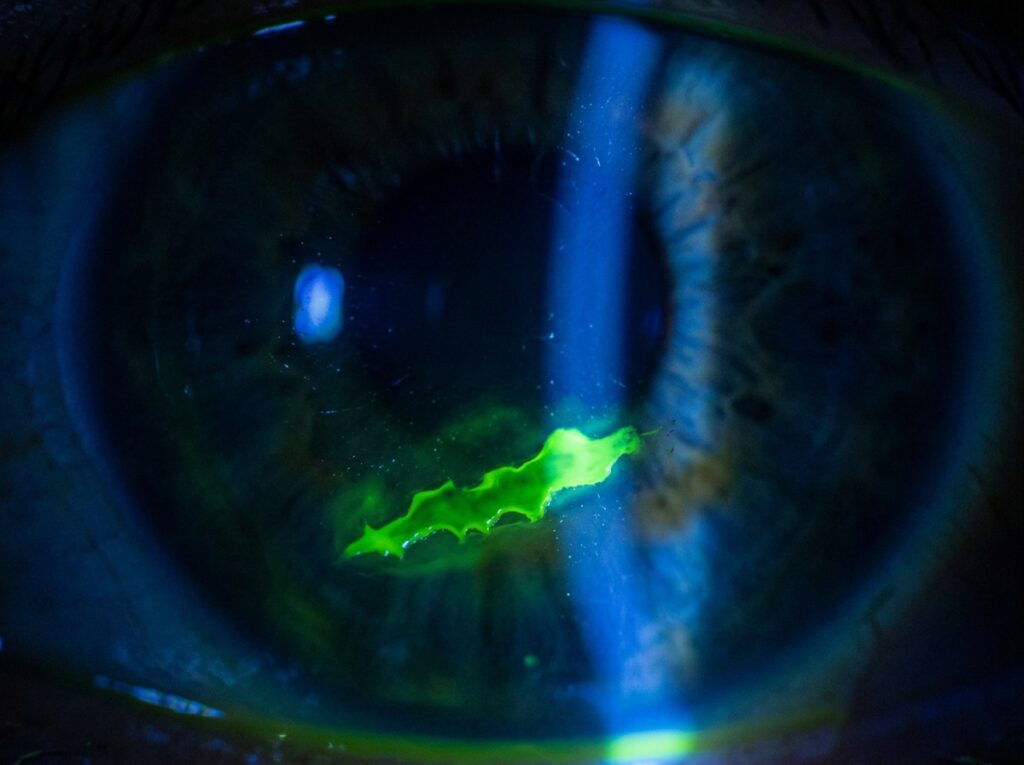
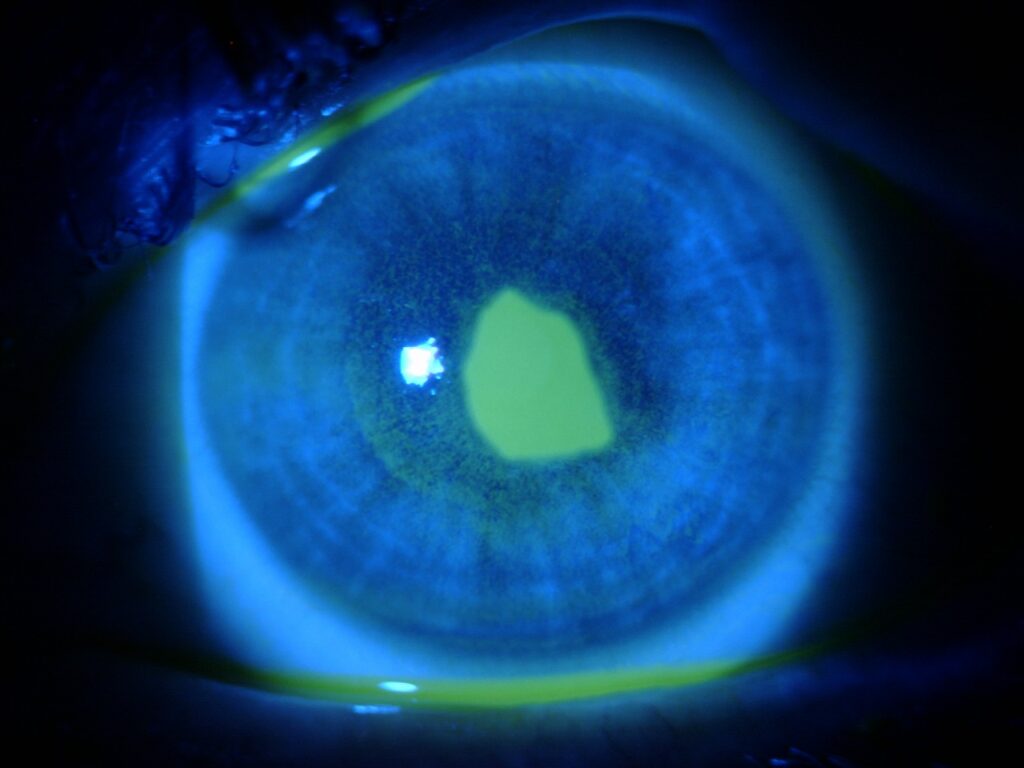
Pain peaks early because exposed nerve endings fire with every blink, and the patient reports tearing, photophobia and a foreign body sensation. At the slit lamp, fluorescein outlines the defect with sharp, bright edges, and mild ciliary flush and a few anterior chamber cells may also appear.
All-fit Slit-Lamp Adapter
Record and share exactly what you see at the slit lamp. One adapter fits any slit lamp or surgical microscope — and any smartphone.
From Choroida — the team behind this siteDay 2 to Day 3
Most small defects close within this window, and the stain then fades to a faint irregular line or a few punctate dots. However, the new epithelium is thin and loosely attached, and as a result, vision may still blur, while mild discomfort on waking is common.
Corneal Abrasion Healing by Size
Size predicts closure time better than the patient’s pain level, and a large central abrasion, for example, may need most of a week. Measure the defect with the slit beam and record its dimensions at each visit, then compare measurements to judge whether the edges are moving.
Depth and the Basement Membrane
Depth matters as much as area, and purely epithelial defects leave the basement membrane intact, so cells reattach quickly. However, fingernails, paper and plant material often tear the basement membrane, and in those eyes, firm adhesion can take weeks to months to rebuild.
What Slows Corneal Abrasion Healing
Several local and systemic factors delay epithelial closure.
- Diabetes mellitus and reduced corneal sensation
- Dry eye and exposure from poor lid closure
- Contact lens wear, especially overnight use
- Repeated use of topical anesthetic drops
- Frequent preserved drops and topical NSAIDs
- Eye rubbing or a retained foreign body
- Prior herpetic disease or limbal stem cell deficiency
Treatment That Supports Corneal Abrasion Healing
Lubrication and a topical antibiotic suit most abrasions, but contact lens wearers need antipseudomonal coverage and no lens wear until the eye is clear. A bandage contact lens can reduce pain in selected patients, whereas pressure patching did not speed closure in randomized trials. For drop choice and the patching evidence, see corneal abrasion treatment myths.
Follow-Up Timing in Corneal Abrasion Healing
Small peripheral abrasions in reliable patients may not need a routine recheck. However, review large or central defects within 24 to 48 hours, and see contact lens wearers within a day because infection risk is higher. Then, review every one to two days until the stain clears.
Warning Signs of Infection
A healing abrasion should hurt less each day, and therefore increasing pain, discharge or falling vision suggests infection. Look for a white stromal infiltrate, haze or hypopyon beneath the defect. These findings point to keratitis and usually call for scraping and culture (see ulcer vs abrasion).
When Corneal Abrasion Healing Stalls
A defect still open after about a week deserves a careful second look. First, evert the upper lid to search for a retained foreign body. Next, test corneal sensation and review every drop the patient uses, and also consider herpes simplex keratitis, exposure and neurotrophic disease.
Recurrent Erosion After Healing
Some patients wake weeks later with sudden sharp pain in the same eye, and this pattern suggests recurrent erosion at the old injury site. The loose epithelium sticks to the lid overnight and tears on opening, and bedtime lubricating ointment may reduce episodes (see recurrent corneal erosion).
Counseling the Patient
Explain that discomfort should improve noticeably each day, and warn that blurred vision may persist briefly after the pain settles. Advise against rubbing and keep contact lenses out until cleared, and finally, give clear return criteria: worsening pain, discharge, a white spot or falling vision.
Corneal Abrasion Healing and Return to Activity
Most people can read and use screens once pain allows. However, drivers should wait until vision is clear and photophobia has settled, and swimming should wait until the epithelium has closed because water can carry organisms.
Pitfalls to Avoid
- Do not dispense topical anesthetics for home use without a clear plan
- Never patch a contact lens related abrasion
- Always evert the upper lid to exclude a retained foreign body
- A stromal infiltrate is keratitis, so never label it a simple abrasion
- Arrange follow-up for every large central defect before discharge


Document what you see
Two smartphone imaging tools built for everyday clinic use — one for the slit lamp, one for the fundus.
From Choroida — the team behind this siteReferences
- Wipperman JL, Dorsch JN. Evaluation and management of corneal abrasions. Am Fam Physician. 2013;87:114-120.
- Lim CH, Turner A, Lim BX. Patching for corneal abrasion. Cochrane Database Syst Rev. 2016;7:CD004764.
- Kaiser PK. A comparison of pressure patching versus no patching for corneal abrasions due to trauma or foreign body removal. Ophthalmology. 1995;102:1936-1942.
- Dua HS, Gomes JA, Singh A. Corneal epithelial wound healing. Br J Ophthalmol. 1994;78:401-408.
- Ljubimov AV, Saghizadeh M. Progress in corneal wound healing. Prog Retin Eye Res. 2015;49:17-45.
Test yourself
A few questions straight from this article.
-
How long does a small corneal abrasion that spares the stroma usually take to heal?
Small defects with an intact stroma usually close in one to three days; larger or deeper injuries close more slowly. -
In corneal abrasion repair, what finally anchors the new epithelium to the basement membrane?
Edge cells flatten and slide across the defect, limbal and basal cells divide to restore thickness, and finally new hemidesmosomes anchor the epithelium. -
Which factor best predicts how long a corneal abrasion will take to close?
Size predicts closure better than pain; measure the defect with the slit beam at each visit to judge whether the edges are moving. -
After a fingernail or plant-material corneal abrasion, why can firm epithelial adhesion take weeks to months?
Purely epithelial defects leave the basement membrane intact so cells reattach quickly, but fingernails, paper and plant material often tear it. -
What extra treatment does a contact lens wearer with a corneal abrasion need?
Most abrasions need lubrication and a topical antibiotic, but contact lens wearers need antipseudomonal cover and no lens wear until the eye is clear. -
What did randomized trials show about pressure patching for corneal abrasion?
Pressure patching did not speed closure in randomized trials, whereas a bandage contact lens can reduce pain in selected patients. -
When should a large or central corneal abrasion be reviewed?
Large or central defects are reviewed within 24 to 48 hours, contact lens wearers within a day, then every one to two days until the stain clears. -
A healing corneal abrasion becomes more painful and shows a white stromal infiltrate. What does this indicate?
A healing abrasion should hurt less each day; increasing pain with a stromal infiltrate, haze or hypopyon points to keratitis. -
A corneal abrasion is still open after about a week. What should be done first?
First evert the upper lid for a retained foreign body, then test corneal sensation, review drops and consider herpes, exposure or neurotrophic disease. -
Weeks after a healed corneal abrasion, a patient wakes with sudden sharp pain in the same eye. What may reduce these episodes?
This suggests recurrent erosion: loose epithelium sticks to the lid overnight and tears on opening, and bedtime ointment may reduce episodes.

Writes and reviews the clinical articles on Educate. Every post is checked against peer-reviewed sources before it goes live.