Corneal abrasion treatment aims to relieve pain and prevent infection while the epithelium heals.
Most abrasions heal within one to three days.
Several old habits persist despite evidence against them.
Confirm the Diagnosis
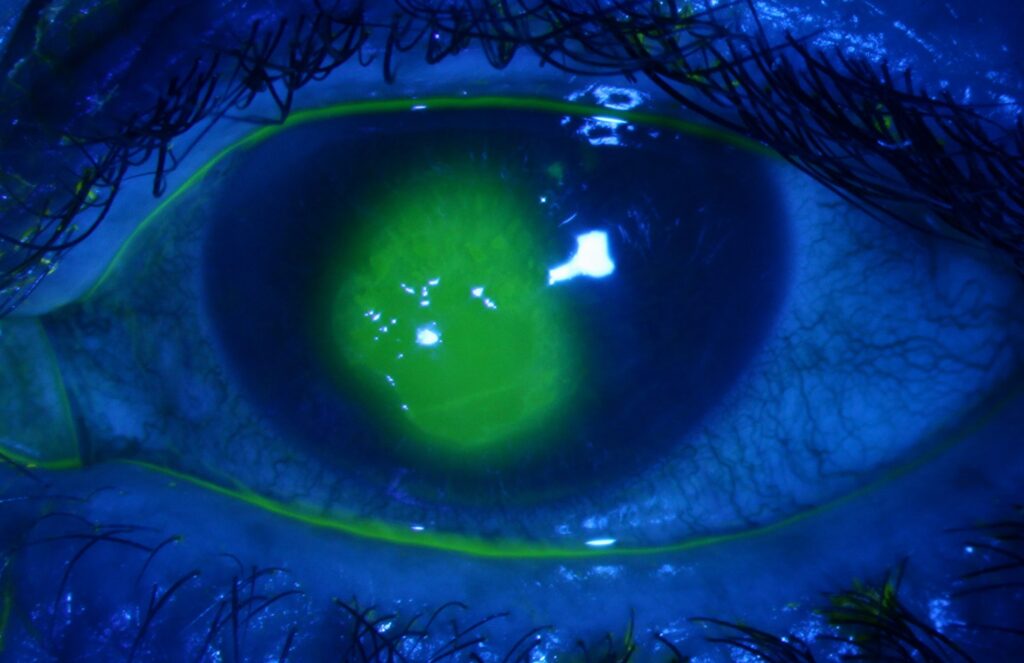
Instill fluorescein and examine with cobalt blue light.
A defect stains bright green (see corneal abrasion).
Look for foreign bodies by everting the upper lid.
Also check for signs of a deeper injury.
Corneal Abrasion Treatment and Pain Control
Oral analgesics such as acetaminophen or ibuprofen are effective.
Cycloplegic drops relieve ciliary spasm in larger abrasions.
Topical NSAIDs may help in selected cases.
Therefore, tailor pain control to severity.
All-fit Slit-Lamp Adapter
Record and share exactly what you see at the slit lamp. One adapter fits any slit lamp or surgical microscope — and any smartphone.
From Choroida — the team behind this siteTopical Anesthetics After the Visit
Small trials suggest that short courses of dilute tetracaine drops can be safe.
However, prolonged use delays healing and can damage the cornea.
Most guidelines advise against sending patients home with anesthetic drops.
So limit them to supervised, short-term use.
Antibiotics
Topical antibiotics lower the risk of infection.
Choose a broad-spectrum drop such as erythromycin ointment or a fluoroquinolone.
Contact lens wearers need coverage for Pseudomonas.
Therefore, ask about lens use at triage.
Patching and Corneal Abrasion Treatment
A Cochrane review found that patching does not speed healing.
It may also increase discomfort.
Patching is also harmful in contact lens wearers.
So avoid patching in routine abrasions.
Steroids
Do not use steroids in the first days.
They delay epithelial healing.
Also, they raise the risk of infection.
Use them only under specialist guidance.
Contact Lens Wearers
Stop lens wear until the eye is healed and comfortable.
Treat with a fluoroquinolone.
Review within 24 hours.
Also look closely for infiltrates.
Recurrent Erosion
Some patients develop repeated erosions on waking.
Lubricating ointments at night help.
Persistent cases need further treatment.
Therefore, explain the risk to patients with fingernail or branch injury.
Follow-Up
Review large abrasions within 24 to 48 hours.
Smaller ones may need only phone follow-up.
Look for infiltrate, hypopyon or reduced vision.
Also confirm epithelial healing.
Red Flags
Increasing pain, discharge or a white spot on the cornea suggests infection.
Reduced vision also needs urgent review.
Therefore, give clear return advice.
Include a contact number.
Counseling Patients
Explain that healing usually takes one to three days.
Advise rest from lenses and avoidance of rubbing.
Also warn about driving if vision is blurred.
Reassure patients about the good outlook.
Pitfalls to Avoid
- Do not send patients home with long-term topical anesthetic
- Never patch an eye of a contact lens wearer
- Avoid steroids in the acute phase
- Do not miss a foreign body under the upper lid
Corneal Abrasion Treatment in Children
Children heal quickly but resist examination.
Fluorescein with a blue light may need sedation or distraction.
Use ointment instead of drops for ease.
Also reassure parents about healing time.
Corneal Abrasion Treatment After Trauma
Ask about the mechanism of injury.
Wood, metal and plant material carry different risks.
High-speed metal needs imaging for an intraocular foreign body.
Therefore, take a careful history.
Corneal Abrasion Treatment and Driving
Blurred vision and light sensitivity limit safe driving.
Advise patients not to drive until vision is clear.
Dilating drops add to the problem.
So warn them early.
Corneal Abrasion Treatment and Work
Most workers can return within a day or two.
Eye protection prevents repeat injury.
Dust and chemicals slow healing.
Also advise rest from screens if symptoms persist.
Corneal Abrasion Treatment of Recurrent Erosion
Lubricating ointment at night prevents the lid from sticking to the surface.
Hypertonic saline can help during the day.
Persistent cases may need other procedures.
Therefore, refer after repeated episodes.
Corneal Abrasion Treatment Follow-Up
Check for resolution of the defect.
Restart contact lens wear only when the eye is white and comfortable.
Keep lubricants for several weeks.
Also give clear return advice.
Corneal Abrasion Treatment: Common Myths
A pressure patch does not speed healing.
Anesthetic drops are not safe for home use.
Steroids do not help the first days.
Therefore, update old habits in your clinic.
Corneal Abrasion Treatment and Prevention
Safety goggles prevent many work injuries.
Trim children’s fingernails to protect infants.
Teach contact lens wearers careful insertion and removal.
Also treat dry eye to protect the surface.
Practical Summary
When a patient presents with a painful red eye, stain the cornea first.
Because most abrasions heal quickly, keep treatment simple.
However, review contact lens wearers early.
Therefore, avoid patches and prolonged anesthetic drops.
For the latest studies, see the PubMed results for corneal abrasion treatment.


Document what you see
Two smartphone imaging tools built for everyday clinic use — one for the slit lamp, one for the fundus.
From Choroida — the team behind this siteReferences
- Lim CH, Turner A, Lim BX. Patching for corneal abrasion. Cochrane Database Syst Rev. 2016;7:CD004764.
- Waldman N, Densie IK, Herbison P. Topical tetracaine used for 24 hours is safe and rated highly effective by patients for the treatment of pain caused by corneal abrasions: a double-blind, randomized clinical trial. Acad Emerg Med. 2014;21:374-382.
- Wipperman JL, Dorsch JN. Evaluation and management of corneal abrasions. Am Fam Physician. 2013;87:114-120.
- Wakai A, Lawrenson JG, Lawrenson AL, et al. Topical non-steroidal anti-inflammatory drugs for analgesia in traumatic corneal abrasions. Cochrane Database Syst Rev. 2017;5:CD004522.
Test yourself
A few questions straight from this article.
-
How does a corneal abrasion appear after fluorescein under cobalt blue light?
Fluorescein is instilled and the cornea examined with cobalt blue light; the epithelial defect stains bright green, and the upper lid should be everted to look for a foreign body. -
Over what period do most corneal abrasions heal?
Most abrasions heal within one to three days, which is why treatment can be kept simple and patients reassured about the good outlook. -
What did a Cochrane review conclude about pressure patching for corneal abrasion?
A Cochrane review found that patching does not speed healing and may increase discomfort, so patching is avoided in routine abrasions. -
Which antibiotic choice suits a corneal abrasion in a contact lens wearer?
Contact lens wearers need coverage for Pseudomonas, so they are treated with a fluoroquinolone, lens wear is stopped and they are reviewed within 24 hours. -
Why are patients with corneal abrasion not sent home with topical anesthetic drops?
Short supervised courses of dilute tetracaine may be safe, but prolonged use delays healing and can damage the cornea, so most guidelines advise against home anesthetic drops. -
Why are topical steroids avoided in the first days of a corneal abrasion?
Steroids delay epithelial healing and raise the risk of infection, so they are used only under specialist guidance and not in the acute phase. -
What is the role of cycloplegic drops in corneal abrasion treatment?
Cycloplegic drops relieve ciliary spasm in larger abrasions, alongside oral analgesics such as acetaminophen or ibuprofen, with pain control tailored to severity. -
Which finding in a patient with corneal abrasion suggests infection needing urgent review?
Increasing pain, discharge or a white spot on the cornea suggests infection, and reduced vision also needs urgent review, so clear return advice should be given. -
Which corneal abrasion patients face a risk of recurrent erosion, and what helps prevent it?
Patients with fingernail or branch injuries are warned about repeated erosions on waking; lubricating ointment at night stops the lid sticking to the surface. -
Which corneal abrasion history requires imaging for an intraocular foreign body?
Wood, metal and plant material carry different risks, and high-speed metal needs imaging to look for an intraocular foreign body, so the mechanism must be taken carefully.

Writes and reviews the clinical articles on Educate. Every post is checked against peer-reviewed sources before it goes live.