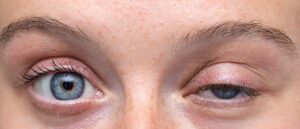
Prism glasses shift the retinal image so both foveas see the same target, which relieves binocular double vision.
They suit small, stable and mostly comitant deviations, but they correct alignment optically and leave the muscle imbalance unchanged. Therefore, patient selection largely decides the outcome.
How Prism Glasses Work
A prism bends light toward its base, so the image moves toward the apex. One prism diopter displaces an image by 1 cm at 1 m. As a result, the apex points toward the deviation and moves the image onto the deviated fovea, while the eye itself does not move.
Who Benefits From Prism Glasses
The best candidates have binocular diplopia from a small, stable, comitant deviation. Examples include age-related distance esotropia, decompensated fourth nerve palsy and residual strabismus after surgery. In addition, prisms bridge the months while a microvascular palsy recovers.
All-fit Slit-Lamp Adapter
Record and share exactly what you see at the slit lamp. One adapter fits any slit lamp or surgical microscope — and any smartphone.
From Choroida — the team behind this siteWhen Prisms Fail
Torsional diplopia does not respond, because a prism cannot rotate an image. Large deviations need powers that blur and distort vision. Variable deviations, as in myasthenia gravis or active thyroid eye disease, change faster than any prescription, and finally, patients without fusion potential may stay diplopic even with aligned images.
Confirm Binocular Diplopia First
First, cover each eye in turn. Diplopia that persists with one eye covered points to the cornea, lens or macula, and prisms cannot help.
A structured history then defines the direction of image separation (see the diplopia differential). Pain, ptosis or pupil involvement demand neurological workup before any optical solution.
Measuring Before Prescribing Prism Glasses
Measure the deviation with the prism cover test at distance, near and in downgaze. A Maddox rod quantifies vertical deviations, while a double Maddox rod measures torsion. Next, place loose or Fresnel prisms in a trial frame and let the patient walk and read, then prescribe the smallest comfortable power, which is often below the measured angle.
Choosing the Base Direction
The base goes opposite the deviation.
- Esotropia: base-out
- Exotropia: base-in
- Right hypertropia: base-down right or base-up left
- Combined deviations: an oblique base calculated from both components
Splitting power between the eyes also balances lens weight and thickness.
Fresnel Prisms
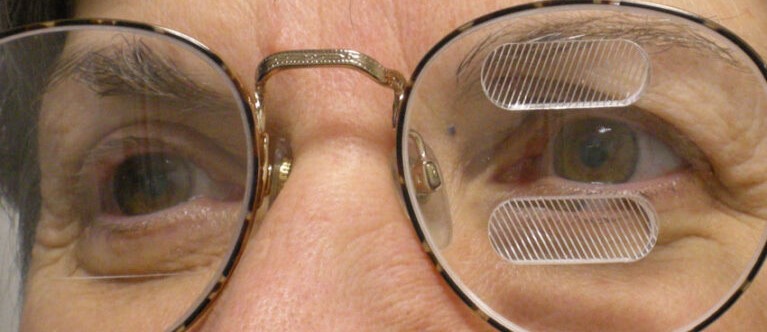
Fresnel prisms are thin plastic membranes that press onto an existing lens. They are cheap and easy to change, so they suit evolving deviations and trials. However, they reduce acuity and contrast, especially at higher powers, and patients also notice visible ridges and chromatic fringes.
Ground-In Prism Glasses
Ground-in prism offers clearer optics and a normal-looking lens once the angle is stable. However, thickness, weight and chromatic aberration rise with power, so clinicians usually reserve it for modest powers, split between both lenses. Lens decentration can also add small amounts of prism through Prentice’s rule.
Tolerance Limits of Prism Glasses
Higher powers induce color fringing, image tilt and curved straight lines, and some patients feel that floors slope while walking. Because of this, a correct measurement can still produce an unwearable prescription. Older patients and those with reduced acuity often accept less prism than expected.
Incomitant Deviations
A paretic deviation changes with gaze direction, so prism gives single vision only in a limited zone, usually primary position and reading downgaze. Patients will still see double when looking toward the weak muscle. For example, a Fresnel segment on the lower lens can target a deviation that worsens in downgaze.
Nerve Palsies and Prism Glasses
In microvascular sixth nerve palsy, a Fresnel prism keeps the patient functional during recovery, and then the power can fall step by step as the deviation improves. Fourth nerve palsy responds best when the vertical angle is modest and torsion is small. Stable large deviations after about six months usually need surgery (see adult strabismus surgery).
Convergence Insufficiency
Base-in reading prisms seem logical for convergence insufficiency. However, a randomized trial in children found them no more effective than placebo glasses. Therefore, vergence therapy comes first in that group, although some presbyopic adults still find small base-in near prism comfortable.
Counseling Patients About Prism Glasses
Explain that prisms relieve symptoms and leave the eye position unchanged. Then describe the trade-offs: mild blur, fringes and an adaptation period. Also warn that new frames can alter the prism effect, and finally, discuss alternatives such as occlusion, botulinum toxin and surgery.
Follow-Up
Review the patient within a few weeks of the trial, and remeasure, because palsies recover and decompensated phorias can progress. Next, reduce Fresnel power as alignment improves, or convert to ground-in prism once stable. A rising requirement suggests progression and justifies further investigation.
Pitfalls to Avoid
- Prescribing prism for monocular diplopia
- Skipping downgaze measurements in readers
- Ordering full ground-in power for a changing deviation
- Promising relief of torsional diplopia
- Delaying workup of an acute palsy for an optical fix


Document what you see
Two smartphone imaging tools built for everyday clinic use — one for the slit lamp, one for the fundus.
From Choroida — the team behind this siteReferences
- von Noorden GK, Campos EC. Binocular Vision and Ocular Motility: Theory and Management of Strabismus. 6th ed. St Louis: Mosby; 2002.
- Tamhankar MA, Ying GS, Volpe NJ. Effectiveness of prisms in the management of diplopia in patients due to diverse etiologies. J Pediatr Ophthalmol Strabismus. 2012;49:222-228.
- Scheiman M, Cotter S, Rouse M, et al. Randomised clinical trial of the effectiveness of base-in prism reading glasses versus placebo reading glasses for symptomatic convergence insufficiency in children. Br J Ophthalmol. 2005;89:1318-1323.
- American Academy of Ophthalmology. Basic and Clinical Science Course, Section 6: Pediatric Ophthalmology and Strabismus. San Francisco: AAO; 2023.
- American Academy of Ophthalmology. Basic and Clinical Science Course, Section 3: Clinical Optics and Vision Rehabilitation. San Francisco: AAO; 2023.
Test yourself
A few questions straight from this article.
-
When light passes through a prism used in prism glasses for diplopia, which way does the image move?
A prism bends light toward its base, so the image shifts toward the apex onto the deviated fovea while the eye itself does not move. -
One prism diopter displaces an image by how much at a distance of 1 metre?
One prism diopter displaces an image by 1 cm at 1 m. -
Which patients with binocular diplopia are the best candidates for prism glasses?
Prisms suit small, stable, mostly comitant deviations such as age-related distance esotropia, decompensated fourth nerve palsy and residual strabismus after surgery. -
Why does torsional diplopia fail to respond to prism glasses?
Prisms shift images but cannot rotate them, so torsional diplopia does not respond and patients should not be promised relief. -
Double vision persists with one eye covered. Where does this point the cause of diplopia?
Diplopia persisting with one eye covered is monocular and points to the cornea, lens or macula, which prisms cannot help. -
Which prism base direction corrects diplopia from an esotropia?
The prism base goes opposite the deviation, so esotropia takes base-out and exotropia base-in. -
Which prism type best suits a recovering microvascular sixth nerve palsy with a changing deviation?
Fresnel prisms are cheap and easy to change, so the power can fall step by step as the palsy improves; ground-in prism waits until the angle is stable. -
A paretic deviation remains large and stable after about six months. What does it usually need?
Stable large deviations after about six months usually need surgery, because large prism powers blur and distort vision. -
What is the first-line approach for symptomatic convergence insufficiency in children?
A randomized trial in children found base-in reading prisms no more effective than placebo glasses, so vergence therapy comes first. -
After a prism trial in a trial frame, what power is usually prescribed for diplopia?
After trying loose or Fresnel prisms while walking and reading, clinicians prescribe the smallest comfortable power, which is often below the measured deviation.

Writes and reviews the clinical articles on Educate. Every post is checked against peer-reviewed sources before it goes live.