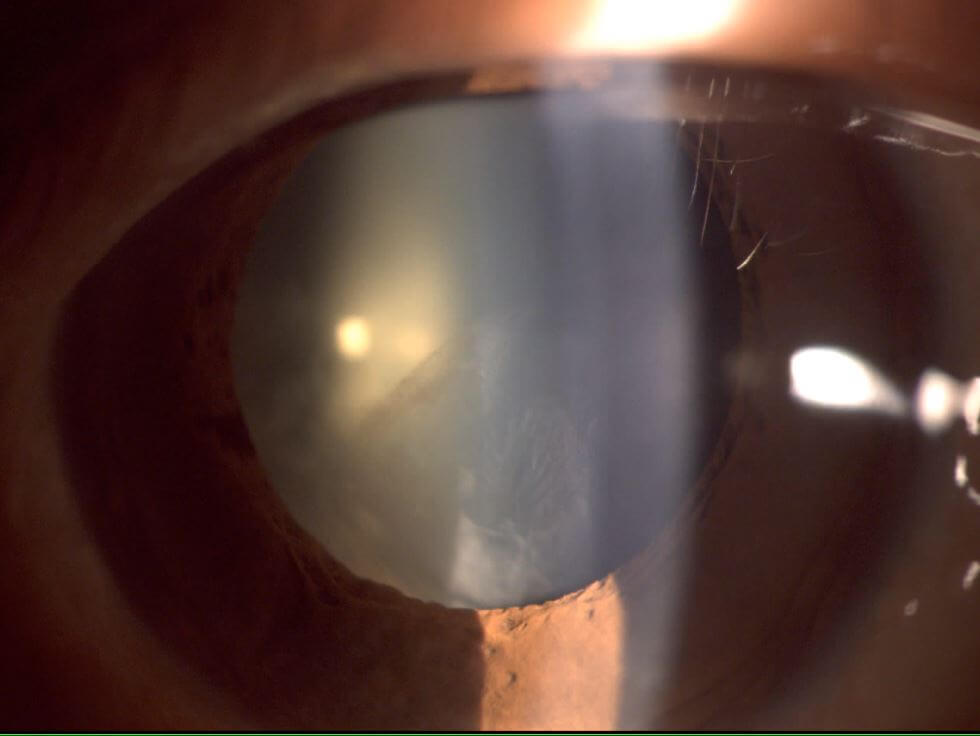
Cataract after vitrectomy is the most common late complication of pars plana vitrectomy in phakic eyes.
It usually appears as nuclear sclerosis within one to two years of surgery.
Therefore, counsel every phakic patient about it before vitrectomy.
How Common Is Cataract After Vitrectomy
Studies report that a large share of phakic eyes develop visually significant lens opacity within two years.
Older patients are affected more often than younger ones.
Also, Cherfan and colleagues reported early nuclear change after vitrectomy for epiretinal membrane.
Because the rate is high, many surgeons plan cataract surgery with the second step of care.
Mechanism of Cataract After Vitrectomy
The vitreous gel normally protects the lens from oxygen.
After vitrectomy, oxygen from the retina reaches the lens more easily.
Holekamp and colleagues showed higher oxygen levels near the lens after surgery.
Also, oxidative damage to the lens proteins drives nuclear sclerosis.
All-fit Slit-Lamp Adapter
Record and share exactly what you see at the slit lamp. One adapter fits any slit lamp or surgical microscope — and any smartphone.
From Choroida — the team behind this siteAge and Cataract After Vitrectomy
Patients over fifty develop cataract faster than younger ones.
Melberg and Thomas found that even younger patients had significant nuclear change within two years.
Also, the lens in older eyes is already stiff and prone to opacity.
Therefore, age shapes the timing but does not remove the risk.
Gas, Silicone Oil and Cataract After Vitrectomy
Intraocular gas increases the rate of lens opacity, especially with long-acting gas.
Thompson reported that gas use and age influenced progression after macular hole and membrane surgery.
Silicone oil also causes cataract, often posterior subcapsular.
Because tamponade affects the lens, include it in counseling (see gas tamponade).
Other Risk Factors
Long operative time, light exposure and infusion fluid may contribute.
Also, steroids used after surgery can cause posterior subcapsular opacity (see steroid-induced cataract).
Diabetes and high myopia add to the risk.
Therefore, review the full set of factors for each patient.
Counseling About Cataract After Vitrectomy
Tell patients that cataract surgery is likely after vitrectomy.
Also, explain that vision may improve after the retinal problem is fixed and then fall again.
Because expectations matter, give the message in writing.
Then document the discussion.
Combined Phacoemulsification and Vitrectomy
Some surgeons remove the lens at the time of vitrectomy in older patients.
This avoids a second operation and improves the view of the retina.
Also, it removes the risk of cataract after vitrectomy.
However, it adds the risks of an intraocular lens in an eye that may need silicone oil.
Phacoemulsification After Vitrectomy
The anterior chamber may be deeper and unstable in a vitrectomized eye.
The lens-iris diaphragm can move backward, and the zonules may be weaker.
Also, careful hydrodissection and low flow help.
Therefore, plan the surgery with an experienced team (see phacoemulsification).
Intraocular Lens Choice
Choose a lens that suits the retinal prognosis and the possible need for future surgery.
A monofocal lens is often the safe choice in eyes with macular disease.
Also, avoid multifocal lenses when the macula is at risk.
Because the retina limits vision, set realistic goals.
Timing of Surgery for Cataract After Vitrectomy
Wait until the retina is stable and the gas has gone.
A short delay allows inflammation to settle.
Also, avoid long delay if the lens blocks the view of the retina.
Therefore, balance the needs of the retina and the lens.
Complications to Anticipate
Posterior capsule rupture, zonular dehiscence and cystoid macular edema are more frequent.
Also, retinal detachment risk is higher after intraocular surgery in an eye with previous detachment.
Because the risks are real, consent carefully (see retinal detachment after surgery).
Outcomes
Most patients gain good vision when the retina is healthy.
Visual results depend on the macula and the optic nerve.
Also, patients who had good vision before cataract usually do well.
Patient Factors That Change the Plan
Diabetes, glaucoma and a small pupil raise the difficulty of later cataract surgery.
Also, a history of retinal detachment calls for extra care with the lens and the capsule.
Because each factor affects the plan, review the eye before you book surgery.
Then discuss the options with the patient and the retina surgeon.
Young Patients
Younger patients also develop lens changes after vitrectomy, though more slowly.
Posterior subcapsular opacity is more typical in this group.
Also, steroid use and silicone oil add to the risk.
Therefore, follow children with serial lens checks.
Visual Symptoms to Ask About
Ask about glare, myopic shift and blurred vision in bright light.
Patients often notice that near vision improves briefly as the nucleus swells.
Also, ask about difficulty with night driving.
Because symptoms guide timing, record them at each visit.
For the latest studies, see the PubMed results for cataract after vitrectomy.


Document what you see
Two smartphone imaging tools built for everyday clinic use — one for the slit lamp, one for the fundus.
From Choroida — the team behind this siteReferences
- Cherfan GM, Michels RG, de Bustros S, Enger C, Glaser BM. Nuclear sclerotic cataract after vitrectomy for idiopathic epiretinal membranes causing macular pucker. Am J Ophthalmol. 1991;111:434-438.
- Melberg NS, Thomas MA. Nuclear sclerotic cataract after vitrectomy in patients younger than 50 years of age. Ophthalmology. 1995;102:1466-1471.
- Holekamp NM, Shui YB, Beebe DC. Vitrectomy surgery increases oxygen exposure to the lens: a possible mechanism for nuclear cataract formation. Am J Ophthalmol. 2005;139:302-310.
- Thompson JT. The role of patient age and intraocular gas use in cataract progression after vitrectomy for macular holes and epiretinal membranes. Am J Ophthalmol. 2004;137:250-257.
Test yourself
A few questions straight from this article.
-
What is the most common late complication of pars plana vitrectomy in phakic eyes?
Cataract is the most common late complication of pars plana vitrectomy in phakic eyes, so every phakic patient should be counseled before surgery. -
How does cataract after pars plana vitrectomy usually present?
Cataract after vitrectomy usually appears as nuclear sclerosis within one to two years of surgery. -
What mechanism drives nuclear cataract after vitrectomy?
The vitreous gel normally shields the lens from oxygen; after vitrectomy oxygen reaches the lens more easily, and oxidative damage to lens proteins drives nuclear sclerosis. -
Which type of lens opacity does silicone oil tamponade often cause after vitrectomy?
Silicone oil also causes cataract, often of the posterior subcapsular type. -
Which gas tamponade most increases lens opacity after vitrectomy?
Intraocular gas increases the rate of lens opacity, especially when a long-acting gas is used. -
Which patients develop cataract faster after pars plana vitrectomy?
Patients over fifty develop cataract faster, although younger patients can still show significant nuclear change within two years, so age shapes the timing but does not remove the risk. -
During phacoemulsification in a vitrectomized eye, how does the anterior chamber typically behave?
The chamber may be deeper and unstable, the lens-iris diaphragm can move backward and the zonules may be weaker, so careful hydrodissection and low flow help. -
Which intraocular lens is often the safe choice after vitrectomy in an eye with macular disease?
A monofocal lens is often the safe choice in eyes with macular disease, and multifocal lenses should be avoided when the macula is at risk. -
When should cataract surgery be timed after vitrectomy?
Wait until the retina is stable and the gas has gone, allowing inflammation to settle, but avoid a long delay if the lens blocks the retinal view. -
Which complications are more frequent during cataract surgery in a vitrectomized eye?
Posterior capsule rupture, zonular dehiscence and cystoid macular edema are more frequent in these eyes, so consent should be careful.

Writes and reviews the clinical articles on Educate. Every post is checked against peer-reviewed sources before it goes live.