Acute hemorrhagic conjunctivitis is an abrupt, highly contagious viral infection that produces subconjunctival bleeding.
It occurs in outbreaks, and it settles within a week in most patients.
Therefore, recognizing the pattern prevents unnecessary investigations and helps control spread.
Viruses Behind Acute Hemorrhagic Conjunctivitis
Enterovirus 70 and a variant of coxsackievirus A24 cause most outbreaks.
Both belong to the picornavirus family.
Chatterjee described the first large epidemic in Ghana in 1969.
Since then, outbreaks have occurred in tropical and subtropical regions.
Epidemiology
The disease spreads through contact with discharge, hands and contaminated objects.
Crowding and poor hygiene favor spread.
Also, the incubation period is short, often one to two days, so outbreaks move quickly through communities.
All-fit Slit-Lamp Adapter
Record and share exactly what you see at the slit lamp. One adapter fits any slit lamp or surgical microscope — and any smartphone.
From Choroida — the team behind this siteClinical Features of Acute Hemorrhagic Conjunctivitis
Patients feel sudden pain, a gritty sensation and watery discharge.
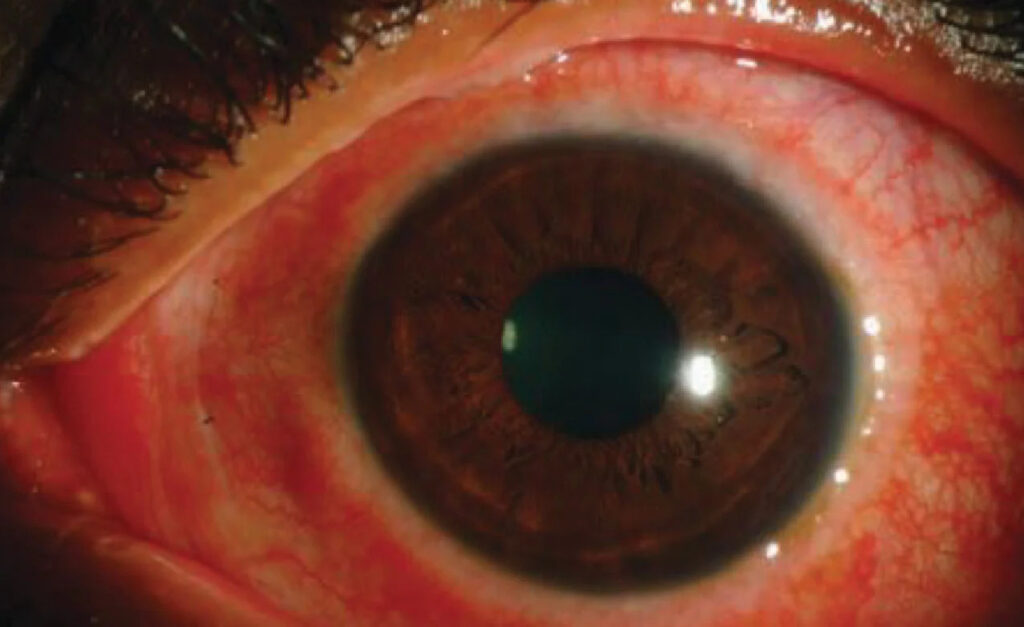
The lids swell, and the conjunctiva shows petechial and then larger subconjunctival hemorrhages.
Follicles, punctate keratitis and a preauricular node may be present.
Because both eyes are often involved within a day or two, patients arrive worried about bleeding.
Differential Diagnosis
Adenoviral keratoconjunctivitis can include hemorrhages (see epidemic keratoconjunctivitis).
Spontaneous or traumatic bleeding causes a single patch without inflammation (see subconjunctival hemorrhage).
Bleeding disorders and anticoagulant use also deserve a question.
Therefore, the sudden onset and the outbreak setting point to the viral cause.
Diagnosing Acute Hemorrhagic Conjunctivitis
The diagnosis rests on clinical signs and the epidemic setting.
Viral culture or polymerase chain reaction confirms the cause during outbreaks.
Also, public health teams may request samples to identify the strain.
Treating Acute Hemorrhagic Conjunctivitis
Supportive care is enough for most patients.
Cold compresses and lubricants ease discomfort.
Topical antibiotics are optional and aim to prevent secondary bacterial infection.
Because steroids offer little benefit, use them only for clear indications.
Preventing Acute Hemorrhagic Conjunctivitis
Hand washing is the most effective measure.
Patients should avoid sharing towels, pillows or eye drops.
Also, schools and workplaces may exclude cases during the acute phase.
Clean examination equipment between patients.
Neurological Complications
Rare cases of radiculomyelitis resembling poliomyelitis followed enterovirus 70 infection.
Therefore, ask about weakness or numbness in patients from outbreak areas.
Also, refer the patient urgently if neurological signs appear.
Incubation and Course
Symptoms begin one to two days after exposure and peak within a day or so.
Most patients recover within five to seven days.
Also, hemorrhages fade over one to two weeks without treatment.
Therefore, reassure patients that the bleeding is not dangerous.
Corneal Involvement
Punctate keratitis is common and causes light sensitivity.
Also, subepithelial infiltrates can occur, as in other viral infections.
Because they are usually transient, observation is enough in most cases.
Outbreak Management
Report clusters to public health teams and keep a line list.
Also, advise affected workplaces and schools to apply hygiene measures.
Because the virus spreads quickly, early action limits the number of cases.
Hygiene in Clinics
Use separate instruments and disinfect tonometer tips between patients.
Also, instruct staff to wash hands after each patient.
Therefore, clinics can avoid becoming a source of spread.
Counselling Points
Tell patients that the eye looks alarming but heals.
Also, suggest cold compresses and avoiding crowded places for a few days.
Because hands carry the virus, repeat the hygiene advice at each visit.
Why the Bleeding Happens
The virus inflames the conjunctival vessels and makes them fragile.
Also, mild trauma from rubbing breaks small capillaries.
Therefore, advise patients not to rub the eyes.
Comparison With Other Causes of Bleeding
Trauma causes a single large patch that is usually painless.
Cough, straining and anticoagulants cause similar patches without discharge.
Because the viral form is bilateral, painful and watery, it is easy to recognize.
Who Is at Risk of Complications
Infants, older adults and immunocompromised patients may have longer courses.
Also, patients with dry eye may have more discomfort.
Therefore, review high-risk patients after a few days.
Use of Medication
Antiviral drugs are not effective for these infections.
Also, topical steroids do not shorten the course and can delay clearance.
Because the disease settles alone, avoid unnecessary medication.
Acute Hemorrhagic Conjunctivitis and Global Health
Outbreaks occur in densely populated tropical regions, and they spread across borders.
Surveillance systems track the viruses and provide early warning.
Also, health teams distribute hygiene advice through schools and media.
Because the illness is self-limited, the main aim is to reduce transmission and avoid panic.
Distinguishing Acute Hemorrhagic Conjunctivitis From Epidemic Keratoconjunctivitis
Both are viral and contagious, but the viruses and the course differ.
Epidemic keratoconjunctivitis lasts longer and leaves corneal opacities that reduce vision.
Also, hemorrhages are more prominent and the onset more abrupt in the enteroviral disease.
Therefore, the clinical pattern and the outbreak setting guide the diagnosis.


Document what you see
Two smartphone imaging tools built for everyday clinic use — one for the slit lamp, one for the fundus.
From Choroida — the team behind this siteReferences
- Chatterjee S, Quarcoopome CO, Apenteng A. An unusual type of epidemic conjunctivitis in Ghana. Br J Ophthalmol. 1970;54:628-630.
- Wright PW, Strauss GH, Langford MP. Acute hemorrhagic conjunctivitis. Am Fam Physician. 1992;45:173-178.
- Azari AA, Barney NP. Conjunctivitis: a systematic review of diagnosis and treatment. JAMA. 2013;310:1721-1729.
- Varu DM, Rhee MK, Akpek EK, et al. Conjunctivitis Preferred Practice Pattern. Ophthalmology. 2019;126:P94-P169.

Writes and reviews the clinical articles on Educate. Every post is checked against peer-reviewed sources before it goes live.