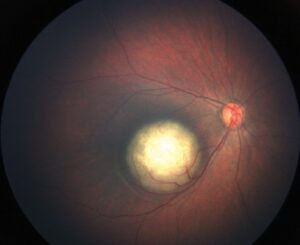
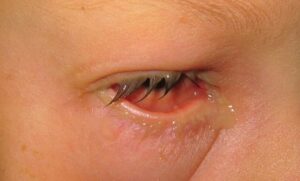
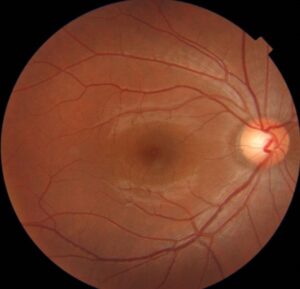
BRAF inhibitor uveitis is an intraocular inflammation that occurs in patients taking vemurafenib or dabrafenib for melanoma.
Most cases are mild and settle with topical steroids.
Therefore, the oncologist can usually continue the targeted therapy.
Clinical Features of BRAF Inhibitor Uveitis
Patients report redness, pain, photophobia, or floaters, typically weeks to months after starting the drug.
Choe and colleagues described anterior uveitis, panuveitis, and a few cases of vitritis.
Also, both eyes are often involved.
Guedj and colleagues described uveitis on vemurafenib that responded to corticosteroids.
BRAF Inhibitor Uveitis With Different Agents
- Vemurafenib carries the most reports
- Dabrafenib is less often implicated, but the combination with trametinib can cause it
- MEK inhibitors add a separate retinal syndrome, which Francis and colleagues described (see MEK inhibitor retinopathy)
All-fit Slit-Lamp Adapter
Record and share exactly what you see at the slit lamp. One adapter fits any slit lamp or surgical microscope — and any smartphone.
From Choroida — the team behind this siteDifferential Diagnosis of BRAF Inhibitor Uveitis
Always consider other causes in a patient with melanoma.
Metastases and masquerade syndromes can mimic uveitis, and checkpoint inhibitors cause their own inflammation (see checkpoint inhibitor uveitis).
Also consider infection in an immunosuppressed patient.
Therefore, take a full drug history and a careful systemic review.
Treatment of BRAF Inhibitor Uveitis
First, give topical steroids and a cycloplegic for anterior disease.
Then add periocular or oral steroids for posterior involvement.
Interrupting the drug is rarely needed.
However, hold the drug in severe cases and restart at a lower dose in agreement with the oncologist.
Why BRAF Inhibitors Cause Uveitis
The mechanism is not fully clear.
Immune activation and paradoxical signaling through the MAPK pathway have both been proposed.
Also, the timing suggests a dose-related effect in some patients.
Therefore, review the dose and the combination regimen when uveitis appears.
Monitoring Patients on BRAF Inhibitors
Offer a baseline eye examination before treatment when possible.
Then teach patients to report redness, pain, light sensitivity, or new floaters promptly.
Also arrange fast access to an ophthalmologist, because early treatment prevents complications.
Check the pressure and look for cystoid edema during follow-up of any uveitis episode.
Finally, share findings with the oncology team, since the eye may reflect broader immune activity.
Ocular Side Effects Beyond Uveitis
Patients on BRAF and MEK inhibitors may also develop dry eye and blurred vision.
MEK inhibitors cause serous retinal detachments that are bilateral and often asymptomatic.
Also, retinal vein occlusion has been reported with MEK inhibition.
Therefore, ask about visual symptoms at each oncology visit and perform optical coherence tomography when in doubt.
Context of BRAF Inhibitor Therapy
Chapman and colleagues showed that vemurafenib improved survival in BRAF V600E melanoma.
As a result, the drug became a standard of care, and ocular events became more visible.
Combination therapy with a MEK inhibitor reduces skin toxicity and delays resistance.
Also, ophthalmologists increasingly work with oncology teams to share monitoring plans.
Practical Points for the Clinician
Grade the inflammation with the standard cell and flare scale, and record the vitreous haze.
Also examine the angle and the posterior pole, because posterior involvement changes the plan.
Then document the oncologic regimen, including dates of dose changes.
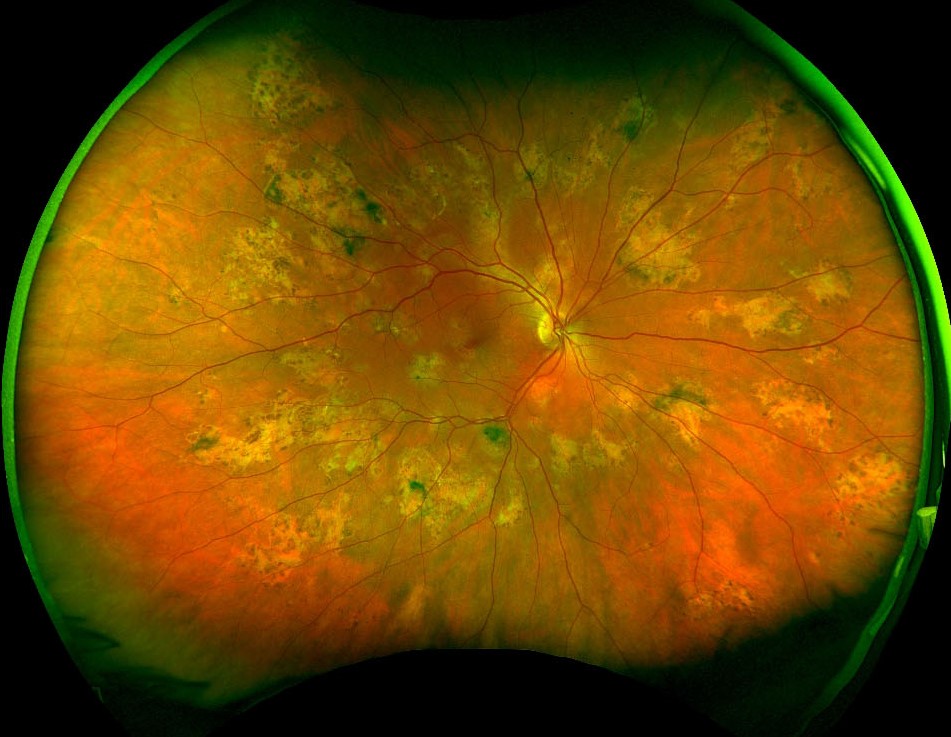
Take photographs of the fundus when there is vitritis or retinal change.
Outcome and Prognosis
Most patients recover fully with topical therapy, and recurrence is uncommon after resolution.
However, chronic cases need slow tapering of steroids.
Also warn patients that new symptoms can return when the dose changes.
Working With the Oncology Team
Send a short note after each visit that states the diagnosis, the treatment, and the expected course.
Because oncologists decide on dosing, clear communication prevents unnecessary interruptions.
Finally, remind them that the eye finding does not mean tumor progression.
Key Points for the Clinician
Uveitis occurs in a small share of patients on these drugs, and most cases are mild.
Also, topical therapy usually suffices, and the cancer treatment can continue.
Because other causes exist, examine the patient fully before attributing the inflammation to the drug.
Then monitor for complications such as cystoid edema and raised pressure.
Finally, communicate with the oncology team early and often.
When to Escalate
Escalate when the inflammation is posterior, bilateral and severe, or when vision falls.
Also escalate when the pressure rises or when the response to topical therapy is poor.
In these cases, add systemic steroids and discuss a drug holiday.
For the latest studies, see the PubMed results for BRAF inhibitor uveitis.


Document what you see
Two smartphone imaging tools built for everyday clinic use — one for the slit lamp, one for the fundus.
From Choroida — the team behind this siteReferences
- Choe CH, McArthur GA, Caro I, Kempen JH, Amaravadi RK. Ocular toxicity in BRAF mutant cutaneous melanoma patients treated with vemurafenib. Am J Ophthalmol. 2014;158:831-837.
- Guedj M, Queant A, Funck-Brentano E, et al. Uveitis in patients with late-stage cutaneous melanoma treated with vemurafenib. JAMA Ophthalmol. 2014;132:1421-1425.
- Francis JH, Habib LA, Abramson DH, et al. Clinical and morphologic characteristics of MEK inhibitor-associated retinopathy. Ophthalmology. 2017;124:1788-1798.
- Chapman PB, Hauschild A, Robert C, et al. Improved survival with vemurafenib in melanoma with BRAF V600E mutation. N Engl J Med. 2011;364:2507-2516.

Writes and reviews the clinical articles on Educate. Every post is checked against peer-reviewed sources before it goes live.