X-linked retinitis pigmentosa is one of the most severe forms of retinitis pigmentosa, with early onset and rapid progression in affected men.
Because mutations in RPGR cause most cases, carrier women may show signs that help to find the family pattern.
Therefore, gene therapy trials now target this form, and accurate diagnosis matters more.
What X-Linked Retinitis Pigmentosa Is
The disease follows X-linked inheritance, so sons of carrier mothers have a 50 percent chance of disease.
First, affected men have night blindness in childhood and lose peripheral vision in the teens and twenties.
Also, many develop high myopia and reach legal blindness by midlife (see retinitis pigmentosa).
RPGR and X-Linked Retinitis Pigmentosa
Meindl and colleagues identified RPGR as the gene for the RP3 locus in 1996.
Vervoort and colleagues found a mutational hot spot in the ORF15 exon.
RPGR mutations account for most X-linked cases, while RP2 mutations account for a smaller share.
Moreover, the gene encodes a protein that sits in the connecting cilium of photoreceptors.
Fundus Explorer Pro
Photograph the retinal findings described here with the phone already in your pocket — 22 D optics and built-in illumination in one handheld unit.
From Choroida — the team behind this siteClinical Features of X-Linked Retinitis Pigmentosa in Men
- Early night blindness and constricted fields
- Myopia and tapetal-like reflex in some patients
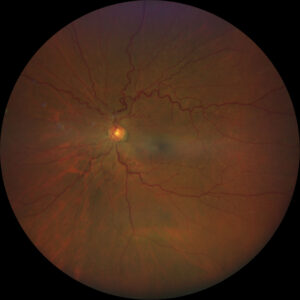
- Bone-spicule pigment and attenuated vessels
- Macular atrophy and cataract in adults
However, severity varies between families and between RPGR variants.
Carrier Signs in X-Linked Retinitis Pigmentosa
Carrier women show variable signs because of X inactivation.
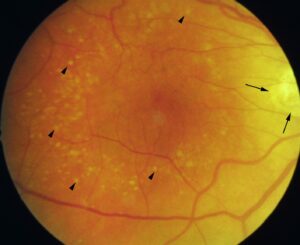
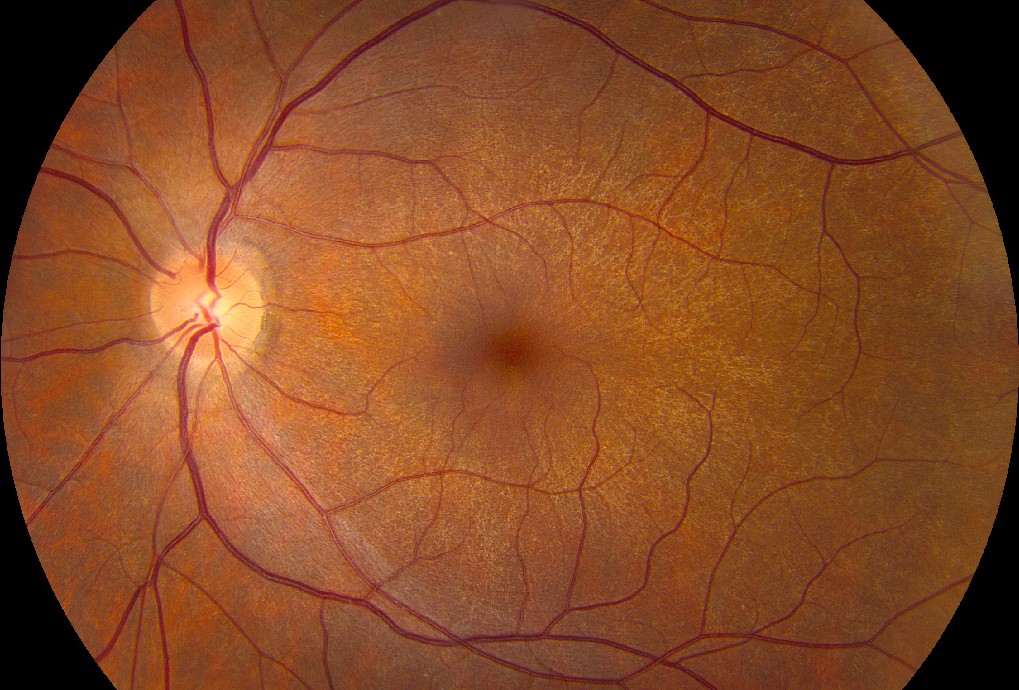
- Tapetal-like reflex, a golden sheen at the macula
- Patchy pigmentary changes and peripheral atrophy
- Mild field loss and reduced ERG amplitude
Some carriers have normal fundi, so a normal exam does not exclude carrier status (see gene therapy for inherited retinal disease).
Diagnosis and Counseling in X-Linked Retinitis Pigmentosa
First, take a three-generation pedigree, and test for RPGR with ORF15 coverage.
Tee and colleagues reviewed the clinical and molecular features of RPGR-associated disease.
Then offer genetic counseling to female relatives, and discuss reproductive options.
Therapy for X-Linked Retinitis Pigmentosa
Gene therapy trials with AAV-RPGR are in later phases and may offer treatment in the coming years.
Meanwhile, care includes cataract surgery, treatment of cystoid edema, and low vision support.
An Example Case
A 12-year-old boy has poor night vision and high myopia, and his fields are constricted.
His mother has a golden reflex at the macula and normal acuity, and her brother was blind in middle age.
Genetic testing finds an RPGR ORF15 mutation in the boy and the mother.
The family receives counseling, and the boy is offered entry into a gene therapy trial.
Questions Patients Ask
Patients ask whether the mother caused the disease, and the answer is that carriers pass the gene by chance and are not at fault.
They also ask whether the boy’s sister is at risk, and she may be a carrier.
Because blame and guilt are common, provide support and clear facts.
Pitfalls to Avoid
- Excluding carrier status because the fundus looks normal
- Using a panel that misses ORF15
- Overlooking myopia and cataract in young patients
- Failing to offer testing to female relatives
Looking Ahead
Gene therapy trials with AAV-RPGR have reported early results, and phase 3 studies are under way.
Also, new vectors target ORF15 with codon-optimized sequences.
Therefore, treatment may become available.
Practical Points
Record a detailed family tree in all patients with RP.
Then ensure that testing covers RPGR ORF15.
Also examine female relatives for carrier signs.
Managing Complications
Treat cystoid macular edema with carbonic anhydrase inhibitors when it occurs.
Remove cataracts to improve function.
Because vision declines, arrange early low vision support.
Quality of Life
Young patients need school and career counseling.
Orientation and mobility training starts early.
Therefore, the care team should include rehabilitation experts.
Testing Female Relatives
Female relatives of an affected man may be carriers, and some have symptoms.
Therefore, examine the fundus with dilation and perform OCT and fields.
Also test for the family mutation when it is known.
Because carriers may develop vision loss later in life, schedule regular follow-up.
Clinical Trials
Gene therapy trials for RPGR enroll men with documented mutations and measurable function.
Therefore, early genetic confirmation matters for access.
Also keep patients informed of registries and updates.
Summary
Think of X-linked disease in a boy with early severe RP and a family history through the mother.
Then test RPGR with full ORF15 coverage.
Because trials need confirmed genotypes, do not delay testing.
Also examine female relatives.
For the latest studies, see the PubMed results for X-linked retinitis pigmentosa.


Document what you see
Two smartphone imaging tools built for everyday clinic use — one for the slit lamp, one for the fundus.
From Choroida — the team behind this siteReferences
- Meindl A, Dry K, Herrmann K, et al. A gene (RPGR) with homology to the RCC1 guanine nucleotide exchange factor is mutated in X-linked retinitis pigmentosa (RP3). Nat Genet. 1996;13:35-42.
- Vervoort R, Lennon A, Bird AC, et al. Mutational hot spot within a new RPGR exon in X-linked retinitis pigmentosa. Nat Genet. 2000;25:462-466.
- Tee JJ, Smith AJ, Hardcastle AJ, Michaelides M. RPGR-associated retinopathy: clinical features, molecular genetics, animal models and therapeutic options. Br J Ophthalmol. 2016;100:1022-1027.
- American Academy of Ophthalmology. Basic and Clinical Science Course, Section 12: Retina and Vitreous. AAO; current edition.

Writes and reviews the clinical articles on Educate. Every post is checked against peer-reviewed sources before it goes live.