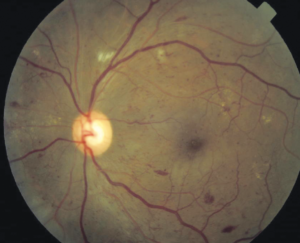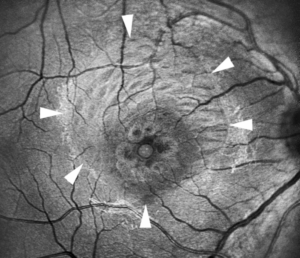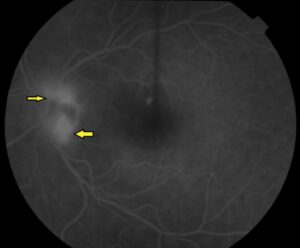
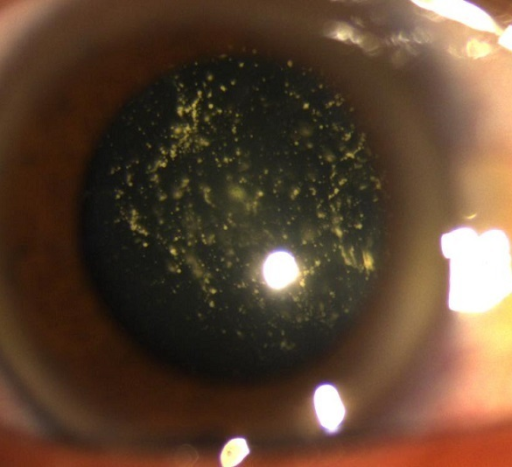
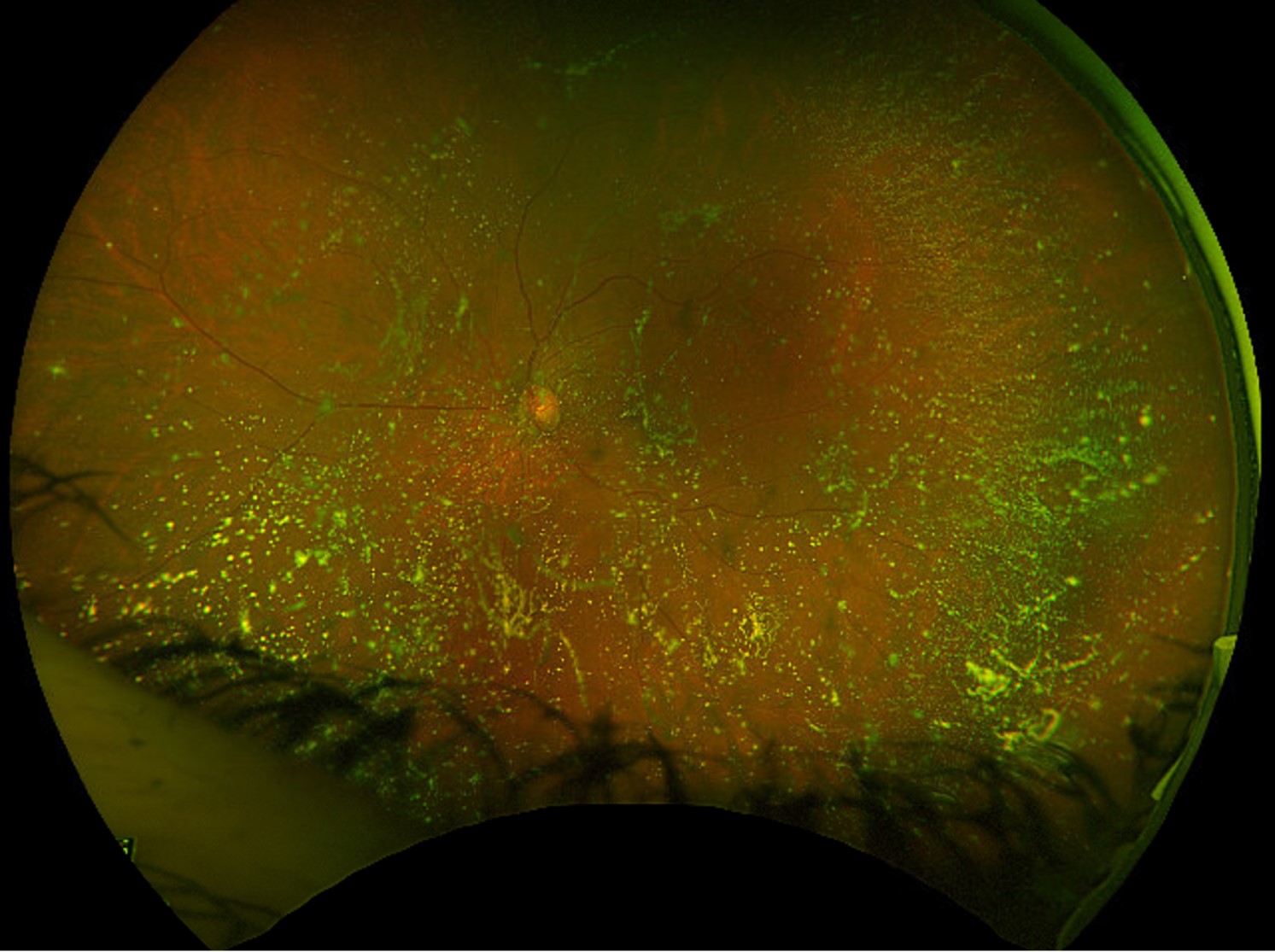
Asteroid hyalosis produces one of the most visually dramatic findings a fundus examination ever turns up, dense, shimmering, star-like opacities scattered through the vitreous that seem like they should cause significant visual disturbance, and yet the great majority of patients with this finding have no visual symptoms at all.
The gap between how striking it looks and how little it usually matters is the single most useful thing to understand about it.
What Are the Opacities?
Asteroid hyalosis is caused by calcium-lipid complexes suspended within the vitreous gel, appearing as multiple small, round, yellow-white refractile bodies that move slightly with eye movement but generally settle back into roughly the same position, unlike the more freely mobile debris seen in other forms of vitreous opacity.
The complexes are typically distributed throughout the vitreous rather than layered inferiorly, which is part of why they can be so visually striking on examination despite causing little functional visual disturbance, since the vitreous gel itself is usually still relatively intact and the opacities, while numerous, occupy only a small fraction of the visual pathway at any given moment.
Epidemiology and Associations
Asteroid hyalosis is more common with increasing age and is usually unilateral, an asymmetry that remains unexplained.
It has been loosely associated with diabetes in some studies, though the association is inconsistent across the literature and is not strong enough to warrant diabetes screening based on this finding alone.
Unlike synchysis scintillans, a different and less common condition with freely mobile cholesterol crystals that settle inferiorly and are usually associated with prior vitreous hemorrhage or significant ocular disease, asteroid hyalosis typically occurs in an otherwise healthy eye without another underlying cause (see synchysis scintillans).
Fundus Explorer Pro
Photograph the retinal findings described here with the phone already in your pocket — 22 D optics and built-in illumination in one handheld unit.
From Choroida — the team behind this siteClinical Significance
- The great majority of patients are asymptomatic, and the finding is often noted incidentally during a routine dilated examination
- Visual acuity is typically normal or only mildly affected even in eyes with dense asteroid hyalosis
- The opacities can significantly limit the view of the fundus, which is the main practical problem they cause, interfering with screening and monitoring of other retinal disease, particularly diabetic retinopathy or age-related macular degeneration
- Imaging tests that rely on a clear view, including OCT, fluorescein angiography, and fundus photography, can be degraded or made uninterpretable by dense asteroid hyalosis, sometimes more than the patient’s own subjective vision would suggest
When It Actually Matters
The clinical importance of asteroid hyalosis is almost entirely about its effect on the examiner’s ability to see the retina, not about visual symptoms for the patient.
- In a patient with diabetes or another condition requiring regular retinal monitoring, dense asteroid hyalosis can genuinely compromise the ability to detect early or progressive disease
- Rarely, patients do report visual symptoms significant enough to affect quality of life, disproportionate to what is typical for the condition
Management
Observation
The overwhelming majority of patients require no treatment at all, since the condition does not progress to threaten vision and the opacities themselves do not damage the retina.
Vitrectomy
Pars plana vitrectomy is reserved for the uncommon situations where dense opacities are genuinely and significantly limiting visualization needed to monitor or treat another retinal condition, or in the rare patient with visual symptoms severe enough to justify the risks of surgery.
Vitrectomy effectively clears the opacities and restores a normal view, but the decision to operate is based on functional need, either for the patient’s vision or for the ability to monitor coexisting retinal disease, rather than on the appearance of the finding itself.
Prognosis
Asteroid hyalosis is a stable, benign condition for the overwhelming majority of patients, and reassurance is usually the only intervention needed once the diagnosis is made and any coexisting retinal disease has been adequately assessed despite the limited view.
Document what you see
Two smartphone imaging tools built for everyday clinic use — one for the slit lamp, one for the fundus.
From Choroida — the team behind this siteReferences
- Mitchell P, Wang MY, Wang JJ. Asteroid hyalosis in an older population: the Blue Mountains Eye Study. Ophthalmic Epidemiol. 2003;10:331-335.
- Moss SE, Klein R, Klein BE. Asteroid hyalosis in a population: the Beaver Dam eye study. Am J Ophthalmol. 2001;132:70-75.
- Yu C, Chen DZ, Green J, Lam WC. Asteroid hyalosis: a systematic review. Surv Ophthalmol. 2019;64:452-462.
- Kim IK, Lane AM, Vander J. Ophthalmic pathology of the vitreous. In: Ryan SJ, ed. Retina. 5th ed. Philadelphia: Elsevier; 2013.
Test yourself
A few questions straight from this article.
-
What are the opacities of asteroid hyalosis composed of?
Asteroid hyalosis consists of calcium-lipid complexes suspended in the vitreous gel, appearing as numerous refractile bodies. -
How do the opacities of asteroid hyalosis appear on examination?
They are multiple small, round, yellow-white refractile bodies, dense and shimmering enough to make the finding visually dramatic. -
How do asteroid hyalosis opacities behave with eye movement?
Unlike the more freely mobile debris of other vitreous opacities, these move only slightly and return to roughly where they were. -
What is the typical visual acuity in an eye with dense asteroid hyalosis?
Even dense asteroid hyalosis usually leaves acuity normal or barely reduced, which is the striking mismatch with how dramatic it looks. -
What is the typical laterality and age pattern of asteroid hyalosis?
The condition becomes more common with age and is usually unilateral, an asymmetry that remains unexplained. -
How should the reported association between asteroid hyalosis and diabetes be interpreted?
The association appears in some studies but is inconsistent across the literature, and is not strong enough to prompt diabetes screening on this finding alone. -
What distinguishes synchysis scintillans from asteroid hyalosis?
Synchysis scintillans has freely mobile cholesterol crystals that settle inferiorly and usually follows prior vitreous haemorrhage or significant ocular disease. -
What is the main practical problem caused by dense asteroid hyalosis?
The opacities can degrade OCT, angiography and fundus photography, hampering screening for conditions such as diabetic retinopathy or macular degeneration. -
When is pars plana vitrectomy justified in asteroid hyalosis?
Surgery is driven by functional need, either severe patient symptoms or an inability to monitor coexisting retinal disease, not by appearance alone. -
What is the usual intervention needed once asteroid hyalosis is diagnosed?
The condition is stable and benign and the opacities do not damage the retina, so reassurance is normally all that is required.

Writes and reviews the clinical articles on Educate. Every post is checked against peer-reviewed sources before it goes live.