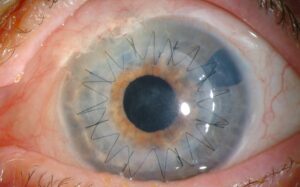
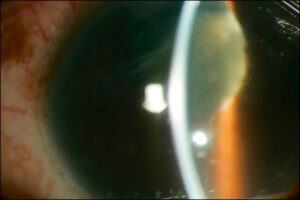
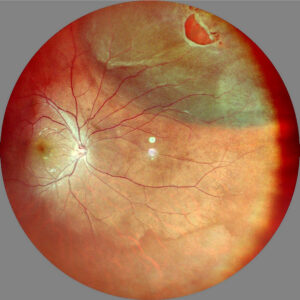
Candida chorioretinitis is a fungal infection of the choroid and retina that follows candidemia.
Yeast reaches the eye through the blood and seeds the chorioretinal tissue. Therefore, it can progress to vitritis and endophthalmitis if it is missed.
How Candida Reaches the Eye
Candida enters the bloodstream from catheters, the gut or the skin, and the choroid receives a large share of blood flow and traps the organisms. Also, the infection starts in the choroid and spreads into the retina, so the disease is endogenous.
Who Is at Risk
Intravenous drug use, central lines and total parenteral nutrition raise the risk, and recent abdominal surgery, prolonged antibiotics and immunosuppression add to it. Preterm infants and patients in intensive care are also vulnerable, so ask about these exposures in every case.
Fundus Explorer Pro
Photograph the retinal findings described here with the phone already in your pocket — 22 D optics and built-in illumination in one handheld unit.
From Choroida — the team behind this siteSymptoms of Candida Chorioretinitis
Early disease may be silent, but patients may report floaters, blurred vision or eye pain. Also, ill patients may be unable to report symptoms, so examination is essential in selected cases.
Signs of Candida Chorioretinitis
Lesions are creamy white, fluffy chorioretinal infiltrates with indistinct borders, and they are often multiple and lie in the posterior pole. Vitreous haze or a string-of-pearls pattern signals spread (see endogenous endophthalmitis), therefore any white lesion in a patient with candidemia needs attention.
Distinguishing Chorioretinitis from Endophthalmitis
Chorioretinitis is limited to the choroid and retina with a clear vitreous, while endophthalmitis involves the vitreous with haze and fluffy balls. The distinction guides treatment, and progression can occur within days.
Incidence of Candida Chorioretinitis
Older studies by Donahue and colleagues reported chorioretinitis in about one in ten patients with candidemia, while newer series report much lower rates. Oude Lashof and colleagues also found that ocular involvement was uncommon, therefore modern rates differ from historical ones.
Screening Guidelines
The Infectious Diseases Society of America recommends a dilated examination in patients with candidemia within the first week. The American Academy of Ophthalmology reviewed the data and suggested a more selective approach, which favors examination in symptomatic or unassessable patients, so practice varies by center.
When to Examine
Examine patients with ocular symptoms and those who cannot communicate, and consider examination in persistent candidemia or high-risk settings. Repeat the examination if fever persists despite therapy, therefore combine guidelines with clinical judgment.
Examination Technique
Dilate the pupil and use indirect ophthalmoscopy to look at the posterior pole and periphery for white lesions and vitreous cells. Document findings with photographs, and repeat in one to two weeks.
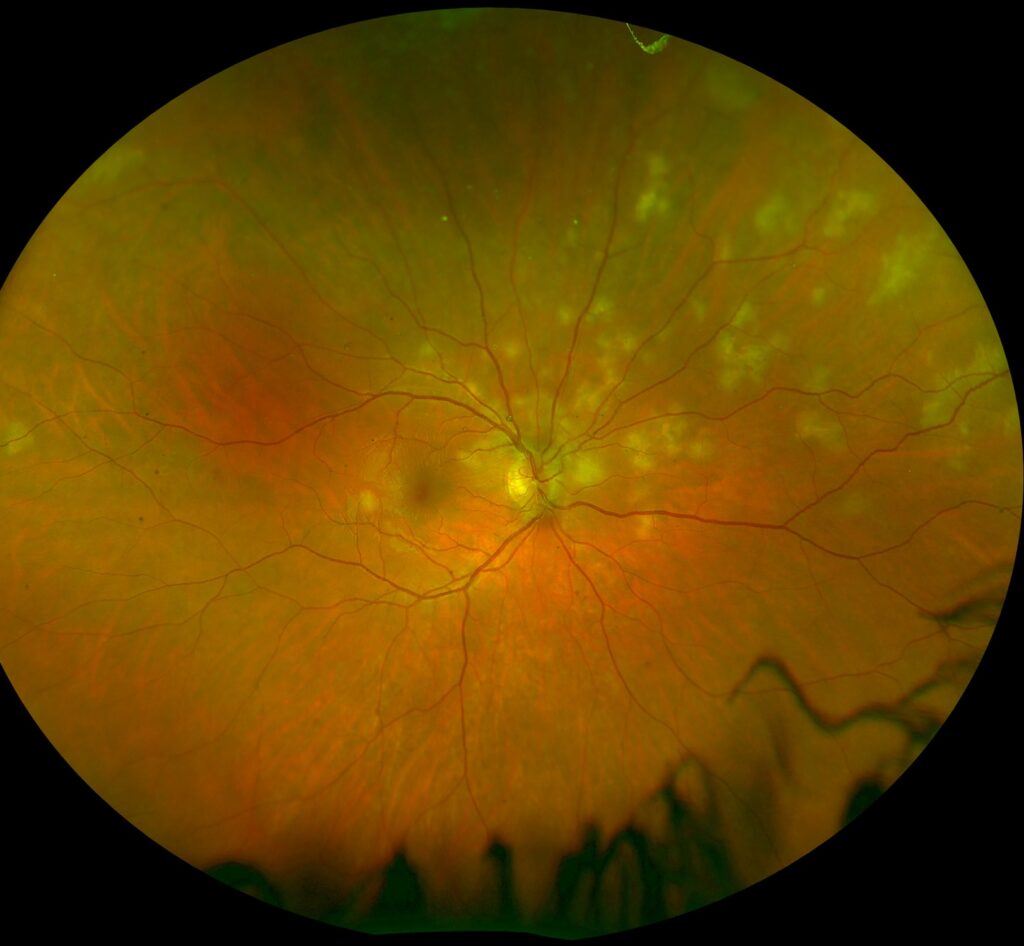
Differential Diagnosis of Candida Chorioretinitis
Cotton-wool spots from sepsis or anemia look similar but are smaller, while toxoplasmosis and cytomegalovirus produce other patterns. Bacterial endogenous endophthalmitis also progresses faster, therefore correlate with blood cultures.
Systemic Treatment
Fluconazole has good penetration into the eye and is a first choice for susceptible species, and voriconazole is an alternative. Echinocandins penetrate the vitreous poorly, so switch from an echinocandin when the eye is involved.
Intravitreal Therapy and Vitrectomy
Vitritis needs intravitreal amphotericin B or voriconazole, and the guidelines advise vitrectomy for substantial vitreous involvement. Early surgery may preserve vision, so involve an eye specialist at once.
Duration of Therapy
Treat for at least four to six weeks and continue until the lesions resolve. Extend therapy if the lesions remain, therefore follow the eye with repeated examinations.
Prognosis of Candida Chorioretinitis
Chorioretinitis without vitritis usually heals with scars and fair vision, but macular lesions cause lasting loss. Endophthalmitis carries a worse outcome, so early detection matters.
Prevention of Candida Chorioretinitis
Remove infected catheters and treat candidemia quickly, and limit unnecessary broad-spectrum antibiotics. Review the need for parenteral nutrition, and educate staff on the risk.
Pitfalls to Avoid
- Do not rely on an echinocandin alone when the eye is involved
- Never skip examination in a patient who cannot report symptoms
- Do not stop treatment before the lesions resolve
- Never assume that negative blood cultures exclude ocular disease
Role of Infectious Disease Teams
Share findings with the infectious disease team at once, because they adjust the drug, the dose and the duration. They also plan catheter removal, therefore close teamwork improves outcomes.
Fungal Species and Resistance
Candida albicans is the commonest species, while Candida glabrata and Candida krusei are less susceptible to fluconazole. Susceptibility testing also guides the choice, so culture results shape treatment.


Document what you see
Two smartphone imaging tools built for everyday clinic use — one for the slit lamp, one for the fundus.
From Choroida — the team behind this siteReferences
- Donahue SP, Greven CM, Zuravleff JJ, et al. Intraocular candidiasis in patients with candidemia: clinical implications derived from a prospective multicenter study. Ophthalmology. 1994;101:1302-1309.
- Pappas PG, Kauffman CA, Andes DR, et al. Clinical practice guideline for the management of candidiasis: 2016 update by the Infectious Diseases Society of America. Clin Infect Dis. 2016;62:e1-e50.
- Breazzano MP, Bond JB III, Bearelly S, et al. American Academy of Ophthalmology recommendations on screening for endogenous Candida endophthalmitis. Ophthalmology. 2022;129:73-76.
- Oude Lashof AM, Rothova A, Sobel JD, et al. Ocular manifestations of candidemia. Clin Infect Dis. 2011;53:262-268.
Test yourself
A few questions straight from this article.
-
In Candida chorioretinitis, in which ocular tissue does the blood-borne infection begin before spreading?
The choroid receives a large share of blood flow and traps circulating yeast, so the infection starts there and spreads into the retina. -
Which exposure raises the risk of Candida chorioretinitis in a hospitalized patient?
Intravenous drug use, central lines and total parenteral nutrition raise the risk, with abdominal surgery, prolonged antibiotics and immunosuppression adding to it. -
When does the Infectious Diseases Society of America recommend a dilated eye examination in patients with candidemia?
IDSA recommends a dilated examination within the first week of candidemia, whereas the AAO has suggested a more selective approach. -
Which patients with candidemia does the American Academy of Ophthalmology's selective screening approach favor examining?
The AAO reviewed the data and favored examining patients with symptoms or those who cannot be assessed, so screening practice varies between centers. -
Which finding separates Candida chorioretinitis from Candida endophthalmitis?
Chorioretinitis is limited to the choroid and retina with a clear vitreous, while endophthalmitis involves the vitreous with haze and fluffy balls; the distinction guides treatment. -
Why should therapy be switched away from an echinocandin when Candida involves the eye?
Echinocandins penetrate the vitreous poorly, whereas fluconazole has good ocular penetration and is a first choice for susceptible species. -
Which intravitreal agent is named for treating vitritis in ocular candidiasis?
Vitritis needs intravitreal amphotericin B or voriconazole, and vitrectomy is advised for substantial vitreous involvement. -
What is the minimum duration of antifungal treatment for Candida chorioretinitis?
Treatment lasts at least four to six weeks and continues until the lesions resolve, with repeated examinations to guide any extension. -
How do cotton-wool spots from sepsis or anemia differ from Candida chorioretinal lesions in a septic patient?
Cotton-wool spots from sepsis or anemia look similar but are smaller; correlating with blood cultures helps, as toxoplasmosis and CMV produce other patterns. -
What is the usual outcome of Candida chorioretinitis without vitritis?
Chorioretinitis without vitritis usually heals with scars and fair vision, although macular lesions cause lasting loss and endophthalmitis does worse.

Writes and reviews the clinical articles on Educate. Every post is checked against peer-reviewed sources before it goes live.