Accommodating intraocular lenses were designed to do what the young crystalline lens does, which is to shift focus from far to near.
The idea is attractive, since it would offer a full range of vision without the halos of multifocal designs.
In practice, the results have been modest, and the lenses are also less used than the alternatives.
The Concept of Accommodating Intraocular Lenses
In a young eye, the ciliary muscle contracts, the zonules relax.
The lens becomes more curved, which raises its power.
An accommodating intraocular lens tries to copy this by moving forward when the ciliary muscle contracts, or by changing its shape.
The lens sits in the capsular bag, so its behavior depends on the health of the zonules and the capsule (see capsular tension ring).
Accommodating Intraocular Lenses: Designs
- Single-optic lenses with hinged haptics, such as the Crystalens, in which the optic is thought to move forward through vitreous pressure when the ciliary muscle contracts (see the references)
- Dual-optic lenses, in which two optics move relative to each other
- Fluid or deformable lenses, which change curvature
- Newer concepts, such as lenses coupled to the ciliary body or using a changing refractive index, which are under study
Only a few designs have reached the market, and some have been withdrawn.
All-fit Slit-Lamp Adapter
Record and share exactly what you see at the slit lamp. One adapter fits any slit lamp or surgical microscope — and any smartphone.
From Choroida — the team behind this siteWhat the Evidence Shows
Studies of the single-optic lens showed good distance vision and better intermediate and near vision than monofocal lenses, although near vision was usually limited.
Many patients needed reading glasses (see the references).
The amount of true accommodation is small.
Some of the near benefit probably comes from pseudoaccommodation, such as the depth of focus from a slight myopic target and pupil effects.
A Cochrane review found that the evidence for the superiority of accommodating lenses over monofocal lenses was of low quality.
The effect on near vision was small (see the references).
Accommodating Intraocular Lenses: Complications and Limits
- Posterior capsule opacification, which can be early and dense, and may require laser capsulotomy (see YAG laser capsulotomy)
- Anterior vaulting of the lens, also called Z syndrome, which is a rare problem in which the optic tilts and produces blur
- Capsular fibrosis, which fixes the lens and reduces movement over time
- Refractive instability and a loss of effect
- Need for a healthy bag, so patients with weak zonules are poor candidates
Because the capsule shrinks and scars over months, the movement of the lens may decline with time.
Accommodating Intraocular Lenses: Who Might Benefit?
- Patients who want good distance and intermediate vision, accept reading glasses, and have healthy eyes
- Patients with low astigmatism, since toric versions are limited
- Those who dislike halos, and who understand the limits
Clinicians offer many patients today other lens types, such as extended depth of focus or multifocal lenses, in the same situation (see extended depth of focus IOLs).
Practical Points in Surgery
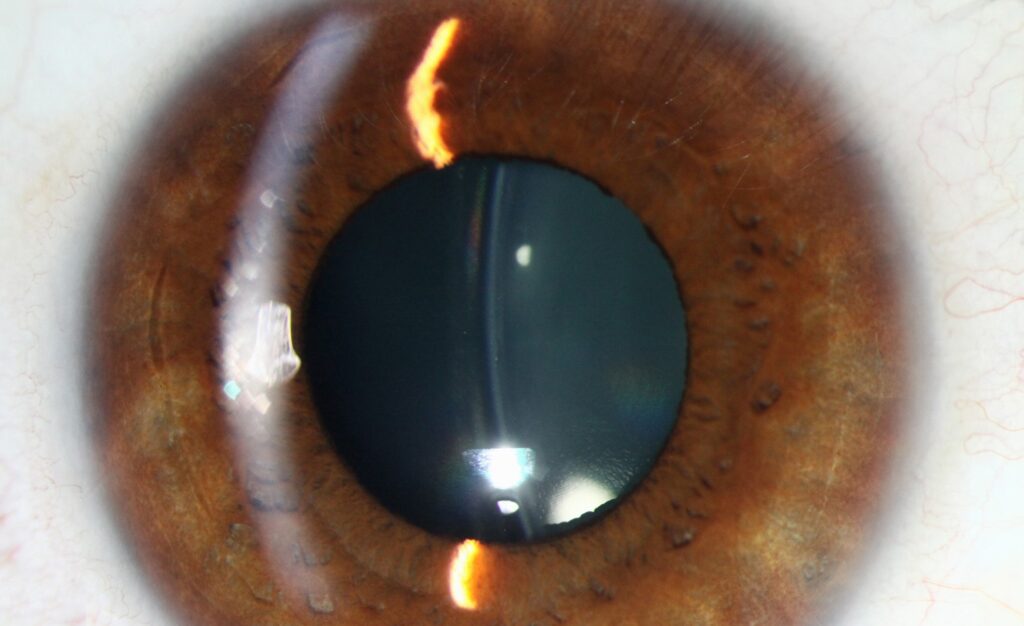
- A well-centered capsulorhexis, slightly smaller than the optic, helps keep the lens in place
- Complete removal of cortex and viscoelastic reduces capsular fibrosis
- Clinicians choose a target close to emmetropia or slight myopia
- Postoperative care includes cycloplegia in some protocols, to help the lens settle and stay in place
Looking Ahead
Research continues on lenses that respond to the ciliary muscle more efficiently, and on refilling the capsular bag with a polymer.
A fully accommodating lens has not yet been shown to be safe and effective in the long term.
Comparing With Other Options for Presbyopia
- Monofocal lenses with monovision: simple and cheap, and with a reasonable range for many patients (see presbyopia)
- Multifocal lenses: a wide range of vision, with a greater chance of halos (see multifocal IOL selection)
- Extended depth of focus lenses: a continuous range, with fewer halos
- Accommodating lenses: the least halos, but with a variable and modest near effect
Each patient needs to balance independence from glasses with visual quality.
Counselling Patients
Explain that the lens may give some help with near vision, that reading glasses may still be needed, and that the effect can change as the capsule heals.
Describe the chance of capsule opacity and the laser treatment that corrects it.
Also, make sure the patient knows that choosing this lens is a matter of preference and that other options are available.
Regular review of capsule clarity in the first year helps detect early opacity.
A prompt laser treatment can restore the benefit of the lens before the patient loses trust in the result.


Document what you see
Two smartphone imaging tools built for everyday clinic use — one for the slit lamp, one for the fundus.
From Choroida — the team behind this siteReferences
- Cumming JS, Colvard DM, Dell SJ, et al. Clinical evaluation of the Crystalens AT-45 accommodating intraocular lens. J Cataract Refract Surg. 2006;32:812-825.
- Ong HS, Evans JR, Allan BD. Accommodative intraocular lens versus standard monofocal intraocular lens implantation in cataract surgery. Cochrane Database Syst Rev. 2014;(5):CD009667.
- Pepose JS, Burke J, Qazi M. Benefits and barriers of accommodating intraocular lenses. Curr Opin Ophthalmol. 2017;28:3-8.
- American Academy of Ophthalmology. Basic and Clinical Science Course, Section 11: Lens and Cataract. AAO; current edition.

Writes and reviews the clinical articles on Educate. Every post is checked against peer-reviewed sources before it goes live.